Showing posts with label All's Well That Ends Well. Show all posts

Thursday, July 20, 2017

Women in Shakespeare: Anwen Darcy on Helena (All's Well…)

Since most Shakespearean casts are male-heavy and even male-only, coverage tends to focus on men who create the work. Let's balance that out! This is the second season of my interview series, Women in Shakespeare. I'm talking with the women who produce and perform Shakespeare and related work in New York City.

Anwen Darcy impressed me a great deal last summer, first in our conversation about Beatrice and then in performance in Much Ado About Nothing. Evidently she's also impressed the Drilling Company, since this is her third season with that prolific outdoor troupe. Directed by Karla Hendrick (who spoke with me on Monday), Anwen plays Helena, the heroine of All's Well That Ends Well, and I'm thrilled to talk with her again.

-----
Let’s start with Helena. What have you discovered about her that you find fascinating?

One of the most fascinating things about playing her is her constant hopefulness — the sheer joy and belief she has in her relationship with Bertram and the fact that they are meant to be together. There is a very strong religious streak in Helena, and her relationship to God is the foundation of all her plans. She believes He has put her on Earth to be with Bertram, and every time a plot of hers fails, she goes back to her faith, and that's been a lifesaver to have, really.

In what way?

When dealing with a situation like the bed trick, you can't frame it in a modern viewpoint. It's only really the past thirty years when that's become an unacceptable plot device (they use it in Revenge of the Nerds, for goodness sake). But giving her a moral reason for doing something unseemly really helped that moment take root in my mind. She's a little like Joan of Arc, in some ways. She has been given a mission and she will not fail.

Which scenes are the most challenging?

I think the hardest scene, for me, is such a little one but it's so important — it's the scene after the wedding, where she asks Bertram to kiss her, and he rejects her. It's a tiny tiny scene — it's maybe two or three pages — but it's humiliating. It's a lot of things — the fact that she can't talk to Bertram alone (Parolles stays onstage, and in our version is silently communicating with Bertram), that she's finally plucking up the courage to ask for something she's wanted for years on top of apologizing to him for surprising him with the wedding — it's just hard. It's a terrible mix of hope and utter ruin. Every night I secretly hope that Bertram isn't going to let her down, and every night he does. I've found that being exposed onstage is hideously uncomfortable for me (as it should be!) but that scene sends chills down my spine every night.

What knots did the playwright leave for you to untangle?

The biggest knot, I think to modern audiences, is the bed trick. How do you get around the lack of consent? Helena certainly has a lot of mental gymnastics in defining it to herself — her justification is that, because she is preventing him from sinning with Diana, and he is instead consummating his marriage to her, it's not a sin at all:

… wicked meaning in a lawful deed,
And lawful meaning in a lawful fact,
Where both not sin, and yet a sinful fact.

So working the audience through something that would very rightly be called rape, and having you come out on Helena's side, has been difficult.

How do you feel about the choices she makes in the play?

The choice to love Bertram, above all, is I think the choice Helena is actively making the entire show. She never stops loving him — even after she gives him up, even after she finds out he's wooing someone else, even after he shows no real remorse she is dead. She is constantly choosing love and devotion, and I think that is what her heart is truly made of. She wants what's best for everyone — herself included, of course, but you see in the show that her happiness above all others is no happiness at all to her. She wants the world to be settled and happy.

How do you see Helena's role in the play’s action?

What is interesting about Helena is how proactive she is without driving the scenes in the first half of the show. Helena never drives a scene until she confesses who she is to the Widow in Act 3, Sc. 7. Before that, she is very much an outsider allowing people to talk around her, before confessing her feelings to the audience in soliloquy. But you see, in the first scene, that nothing gets past her. She's sobbing because Bertram's leaving and is adrift in her own misery, but she's still listening, still hears LaFew talk about the King's disease, and by the end of scene 1 in the show, she's figured out a plan. She's going to go to the King, and solve his problem, and in her words, "Who ever strove to show her merit that did miss her love?" It's a really beautiful plan, in a lot of ways, because it very neatly solves her status issues, which she believes are the only thing getting in the way of her being with Bertram.

What about subsequently?

Throughout the show, you see Helena setting up dominoes to fall, cutting paths to lead herself to Bertram, and finding out it's more difficult than she believes. So she is the engine of the whole show, but again, doesn't drive the action until the back half — it's the Countess and the King and Bertram who make decisions for her in the beginning. The Countess agrees to let her go to Paris, The King agrees to let her try her physic and gives her leave to marry Bertram. Bertram leaves instead of staying and working on the marriage. Acts 1-3 are really constant up and down that is simultaneously Helena's doing (she engineered all the situations) and her reacting to the decisions of those higher up (the King, Bertram, the Countess).  It's only when she leaves France, when she leaves her marriage and agrees to lose everything, that we see her come into her own.

Last summer, you remarked that Shakespeare’s biggest flaw regarding female roles is that “once an intelligent, complicated woman has served her purpose, she stops talking.” Does Helena fit that dramaturgical pattern?

Helena does fit into that pattern. The more she becomes self-actualized, the less we see of her. We don't really know how she feels after that night with Bertram. She never tells us. The soliloquies inviting us into her headspace are gone. She's silent on what it felt like to have the man you've adored since childhood finally come to you as a husband but think you are someone else. She's totally silent on her humiliation of his love of Diana — and it had to be humiliating, to stay at the Widow and Diana's house, and see the musicians that Bertram has sent for someone else. Helena's scenes are much more blunt and to the point in Act 4 and 5 — much shorter, and her long, rambling speech pattern of earlier is gone. Some of that is to do with the fact that she's grown up — and I think some of it is to do with the fact that Shakespeare found her less interesting when she isn't mired in misery.

What about the final stage of her journey? Where does Helena end the play?

Act 5 is interesting, because it's a lot of people talking around problems that Helena could solve. So instead of getting Helena and Bertram having a satisfying resolution to talk about their problems, Helena just wanders in on the last page, pregnant, and they embrace. He says if she can prove it was her in Florence, he'll love her dearly. She says if he can't see it clearly by now, they should divorce. Everyone laughs. End play — and it's terrible. I have no idea why he felt the need to have Parolles talk in circles about the Diana/Bertram situation for three pages when the audience is already ahead of you, and not let the central romance breathe and solidify.

What does Helena share with Shakespeare’s other adventurous, crossdressing ingénues — roles like Rosalind, Portia, and Viola?

Well, it's interesting, because the crossdressing is so incidental to the show. It's not vitally important as in As You Like It, or Merchant or Twelfth Night, because it's really just a scene. What it does represent within the show is Helena at her lowest — she's failed as a woman, in her eyes. She was given everything she wanted, and her husband rejected her. She humiliated him, she humiliated the king, the Countess — Helena takes the failure of her marriage to Bertram extremely personally, and by sending herself off on a pilgrimage so he can come home, she is literally exchanging herself in the eyes of God, which is where the cross-dress comes in. She needs to be an equal sacrifice.

But I think the spirit of fearlessness is alive and well in all four of these women — they are all women who will lay themselves on the line for others and to get things accomplished. They are all doers, and self-made women, even in times when that wasn't necessarily socially acceptable. I think people tend to think of Helena as a bit of a doormat for Bertram, and she certainly takes licks that the three ladies mentioned would not, and I think that's where she differs. You see Helena grow into her strength — you see her form before your eyes. Whereas someone like Portia is already a formidable wit and self possessed women, this is Helena's journey to get there.

Turning to the play, what does All’s Well offer audiences that Shakespeare’s more famous plays don’t?

I'd been begging to do this show for years, actually. I've always loved Helena, but it's a hard show to do because everyone has to have a specific skill set. You have to have a Bertram that's charming enough [that] you love him but you also believe him doing terrible things. You have to have a Parolles that seems harmless enough to stay with Bertram but has a dark edge when alone, a Countess who is strong but indulgent. Luckily for us, we actually had the right people for the task this year and the show leapt forward.

What do you love about All's Well?

One of the things I love about this play is that it's really about communication, more than anything. It's about actually listening, and solving problems. So many of the problems in this show — Bertram and Helena's relationship, Bertram's friendship with Parolles, Bertram running away, Helena running away — could be solved by actually talking things out. Everyone takes the most difficult path to get to a certain point. And I think that it's a great tale of love overcoming our own idiocy.

We live in a period where there is a lot of talking and not a lot of listening, particularly if we don't like what's being said. So instead of problem-solving in the beginning (when it's hard and awful) we wait, and tune out, and hope someone else fixes the problem. And no one does, and problems get worse, and things spiral out of control. That's what happens here.

Of course, we have a happy ending in this show — all's well that end's well, after all — but what makes this show interesting is that we are on the knife's edge of a tragedy. The only way that this show ends happily is if everything goes exactly as it does. The end of the show always reminds me a bit of Titus, without the body count. So much information being given, and so much of it could be received badly. I think that's interesting for the audience, who likely haven't seen this show before. How will it end? What's going to happen? I would actually love to do a dark, dark version of this show — it's very Gone Girl, in a lot of respects — if Helena's actions aren't fundamentally good, then the foundation and world of the show become very, very different. And that's why I love about this show — it's an enigma that can be played a thousand different ways.

We talked last summer about other roles in Shakespeare they’d love to play, male or female. This summer I’d like to ask about your most formative shows have been, Shakespeare-wise.

My first Shakespeare was playing Hermia, at a place called Monomoy Theatre, and it was just absolute perfection. It was a full scale, old Greek romantic mounting of the show, and I had the best other lovers to work with, the best director. I just remember that entire show being a joy. So it was love at first production, really.

Do you have any idols or strong influences in your approach to Shakespeare?

I think in terms of idols, I remember watching Kate Winslet in Kenneth Branagh's Hamlet and just being riveted by how conversational her Ophelia was, the hidden strength and humanity in her gentleness. That's something I keep coming back to for Helena. How do you keep the core of steel but still be gentle, still be unscarred by the world?

What about performances outside of Shakespeare?

I've weirdly watched a lot of early Judy Garland for Helena — that doe-eyed, firm feeling of "I can do this even though I'm scared." I can't neglect to mention that Audrey Hepburn's Sabrina was a huge influence on how I played Helena. Sabrina and David's relationship in the beginning of the film is close kin to Helena and Bertram — Sabrina even bemoans that she is reaching for the moon, similar to Helena's first monologue citing Bertram as a star, he's so far above her.

Thank you for taking the time to chat!

-----
The Drilling Company's All's Well That Ends Well plays from Jul 6 to Jul 22 at the Clemente Parking Lot, 114 Norfolk, on the LES. Tickets are free!

-----

headshot  Jody Christopherson
photos  Lee Wexler/Images for Innovation

Monday, July 17, 2017

Women on Shakespeare: Karla Hendrick on directing All's Well…

Since most Shakespearean casts are male-heavy and even male-only, coverage tends to focus on men who create the work. Let's balance that out! This is the second season of my interview series, Women in Shakespeare. I'm talking with the women who produce and perform Shakespeare and related work in New York City.

By my count, almost half of NYC's Shakespeare is directed by women in summer '17! The Drilling Company, which stages five plays per summer, has a pair of female directors. This week I've interviewed Karla Hendrick, director of All's Well That Ends Well (I'll be speaking with her Helena on Thursday). A stalwart of the Drilling Company, Ms. Hendrick has previously played Gertrude with the company; this is her directorial debut.
-----
Let’s start with All’s Well. What knots did the playwright leave for you and your cast to untangle?

Great question! And there are plenty of knots with this play! All’s Well That Ends Well is categorized as one of Shakespeare’s three “Problem Plays”, perhaps because of the quick turn of events at the end propagated by an event never seen, perhaps because there is so much exposition, perhaps the quick shifts in tone; for whatever reason, it’s not frequently produced. And to a contemporary audience, it could be seen solely as the story of a smart woman who falls for the bad boy and subsequently makes dumb choices; or even a story about a cocky young man who has the heart of a woman and yet treats her badly.

How do you meet that challenge?

When I examined the play through the lens of a coming of age story, Helena’s journey became clear and distinct and the strongest through-line of the play. Add to that the fact that Bertram, too, undergoes a clear journey, then the story opens up and begins to come together. There’s arguably a real turning point for Bertram too in the play when he becomes a war hero. Granted, the challenge is in making sense of Bertram’s journey (and that difficult final scene!) and creating a Bertram that the audience can both wince at and learn to love — but that’s what makes Shakespeare’s characters so human. Of course, the key to the final scene is setting up that final Bertram moment earlier in the play. 

What have you discovered about the play that you find fascinating?

What fascinated me most about this play is the discovery that Helena is not the only character with a clear journey, but, in fact, most every character in the play has one. We uncovered them. Also I was surprised by how strong are the themes of the healing power of the feminine and the power of forgiveness.

Had you read or seen All’s Well before this production?

I’ve never seen a stage production of All’s Well, and hadn’t read it in a very, very long time. It took some time before I felt comfortable approaching it and delving in, it intimidated me tremendously to begin with! The more we peeled off its layers, the more I absolutely fell in love with it. It also became something of a personal story for me, and now is definitely a great time to produce it — there’s quite a lot in it that resonates with audiences of today!

Why is it the right play to revive this summer in NYC?

We live in a society and a world right now that desperately needs a message of healing, of forgiveness, of persistent belief in “all’s well that ends well”, and how that message can drive one forward in a positive, proactive and undaunted way. We also need desperately to hook into stories of personal change and of the healing power of women and communities of women.

What does it offer audiences that Shakespeare’s more famous plays don’t?

I liked the idea that as the characters live out their lives and journeys, there’s a constant shadow over the story of the impending unknown (we know what’s about to happen to their country, they don’t). One of my favorite lines in the play is: “The web of our life is of a mingled yarn, good and ill together”. I think that’s the play in a nutshell. The joy the characters feel is overshadowed by a constant cloud; their despair is followed by joy, their joy is followed by despair. It’s very Chekhovian in that sense, and very much like life. That’s reflected in the tone with which I approached the work — moments of hilarity turn sharply to moments of touching pathos which may turn to moments of deep despair. And back again. Just like life.

Did you set it in contemporary New York, or another place and time?

It is set in France, and there are many references to the war in Italy, so I chose to set it during WWII in France just before Mussolini’s Fascist invasion in 1940, a moment in history when many Italian soldiers turned and fought against Fascism, which meant fighting against their own countrymen. Many Frenchmen then fought beside them. It highlights certain conflicts that may resonate acutely with us as a society today while honoring the original text, but without hitting us over the head with it or forcing any contemporary connections.

How do you feel about the choices Helena makes in the play, and the ones taken out of her hands?

Helena is making bold choices. Unapologetically. But she doesn’t start there, she has a clear journey. She takes risks and with each success, she gathers strength. I see the famous virginity scene with Parolles as an early victory; his apparent intimidation or at least verbal banter with her is unsuccessful in quieting her; her “thousand loves” speech is, in a way a big early success which frees her. She makes a huge discovery from that exchange with Parolles, that “our remedies oft in ourselves do lie.” It’s the first real moment of growing up and standing on her own two feet. Some might ask why she goes after Bertram who has only disdain for her, why does she even love this loser at all? It’s because she sees into his heart, and, having grown up with him, knows his heart and knows his most true, authentic self — who he is away from Parolles, even — a self that’s been lost along the way in the journey he’s on. She may be, in a sense, on a rescue mission; the love she feels for him throughout is powerful and drives her forward continuously; the forgiveness she offers him in the end is world-changing. Her journey is, hopefully, the audience’s journey.

This production is staged in a Lower East Side parking lot. How do you address the challenges of outdoor Shakespeare?

Oh, my, and there are challenges! Time constraints, rain, heat, storage, you name it. It is challenging to do any play in a venue such as this, but the rewards are tremendous. Free Shakespeare isn’t really free; yes, it is something we give the audience without monetary cost, of course, but they do give a lot — not only their time and attention, but their laughter, their tears, their hearts and souls for two hours time which is the greatest exchange in the world. We and the audience create something together in that space that will never happen again in that way and that makes any challenge fade fast.

How has the urban space shaped your vision of the play? 

The venue has shaped the vision mostly since opening, in that the energy of the audience has taught us much about the story. As the numbers of audience members have increased, we’ve adjusted the set to accommodate more people, to create an even more accessible, intimate experience for them. And we’ve allowed more breathing space for the audience to come in as the final character.

Talking about Shakespeare more generally, what’s your perspective on his roles for women?

No one knew women like Shakespeare did — at least of the writers of his day — because no one knew humanity like he did. I think there is quite a lot in Shakespeare’s plays that artists could focus on more; for example, the Italian women in All’s Well (in our production they are a community of immigrant women living in Italy) could easily be glossed over, theirs are such short scenes and one might say the women are there to facilitate the bed trick plotline only. And yet they are the ones who Helena meets after she hits rock bottom and they reach out to her. It’s a “healing the healer” situation; the Widow takes her in, and we don’t really know how long Helena stays, but we do know that it is there that she hatches her plan and begins to run with it, getting them on board to play all the parts. Her time in their community allows her to pick herself up and move forward. They are her turning point.

What are his strengths or weaknesses in depicting women?

I’ll go out on a limb here and say that his is the strength, and if there’s a weakness, perhaps the weakness belongs to artists who may short-change those characters or their interpretation of them. Perhaps we don’t give his women enough power sometimes — the power they may be written to have. But then again, perhaps Shakespeare’s weakness in depicting women was simply in not writing enough of them! (And of course, in the constraints he was working with regarding their role in society — not his fault — and even within that, he broke through time and time again).

Do you have any experimental takes on Shakespeare—an all-female cast, or a radical adaptation—that you’d love to stage?

In this production we have cast a woman as LaVatch, the fool, traditionally played by a man. She’s playing it as a woman and having a great time with it! Switching LaVatch’s gender opened up a lot for us thematically and with the story line, actually, we were still making discoveries late into the process.

Do you have a short-list of Shakespearean plays to direct?

I’ve always wanted to do Comedy of Errors with two female Dromio’s; I’d love to do Romeo and Juliet with two women (last season the The Drilling Company, who also produces Bryant Park Shakespeare, cast a woman as Mercutio – she’s now playing our Helena).

-----

The Drilling Company's All's Well That Ends Well plays from Jul 6 to Jul 22 at the the Clemente Parking Lot, 114 Norfolk, on the LES. Tickets are free!

-----

headshot  n/a
photos  Lee Wexler/Images for Innovation

Tuesday, September 23, 2014

How Not to Stage Shakespeare

Writing about deBessonet’s Winter’s Tale last week, I barely touched on Todd Almond’s massive contribution. Their Tale is a musical, less of a departure than Kiss Me Kate but still a radical revision. They retain whole scenes of Shakespeare, but they also supplement the speech with songs in a modern idiom as well as new dialogue. They recast Almond’s Antigonus as a second chorus, an MC whose post-mortum perspective (he’s the character who “exits, pursued by a bear” in Act 3) enhances the play’s melancholy. The device also links the polyphonic tones and styles of the original play with its musical, comedic, and choreographic additions. It’s the keystone to this Tale’s success.

I believe that polyphony is a fundamental element of Shakespeare’s dramaturgy. Not incidentally, I think it’s also the aspect that’s most often ignored, to the detriment of mainstream productions (& audiences!). There’s a lot of Shakespearean theater in NYC these days, but it’s pretty homogenous. The direction has narrow range of tone, a steady pace, and most importantly, a conceptual framework to give unity to the production. These approaches fall into a few conventional categories:

1. Modern Shakespeare: to underscore Shakespeare’s relevance, the director puts the characters in modern business attire (for a tragedy or history) or contemporary fashion (comedy, romance)

Romeo and Juliet
David Leveaux, 2013

2. Retro Shakespeare: to keep faith with the plays’ cultural contexts, the production pulls out the doublets and hose

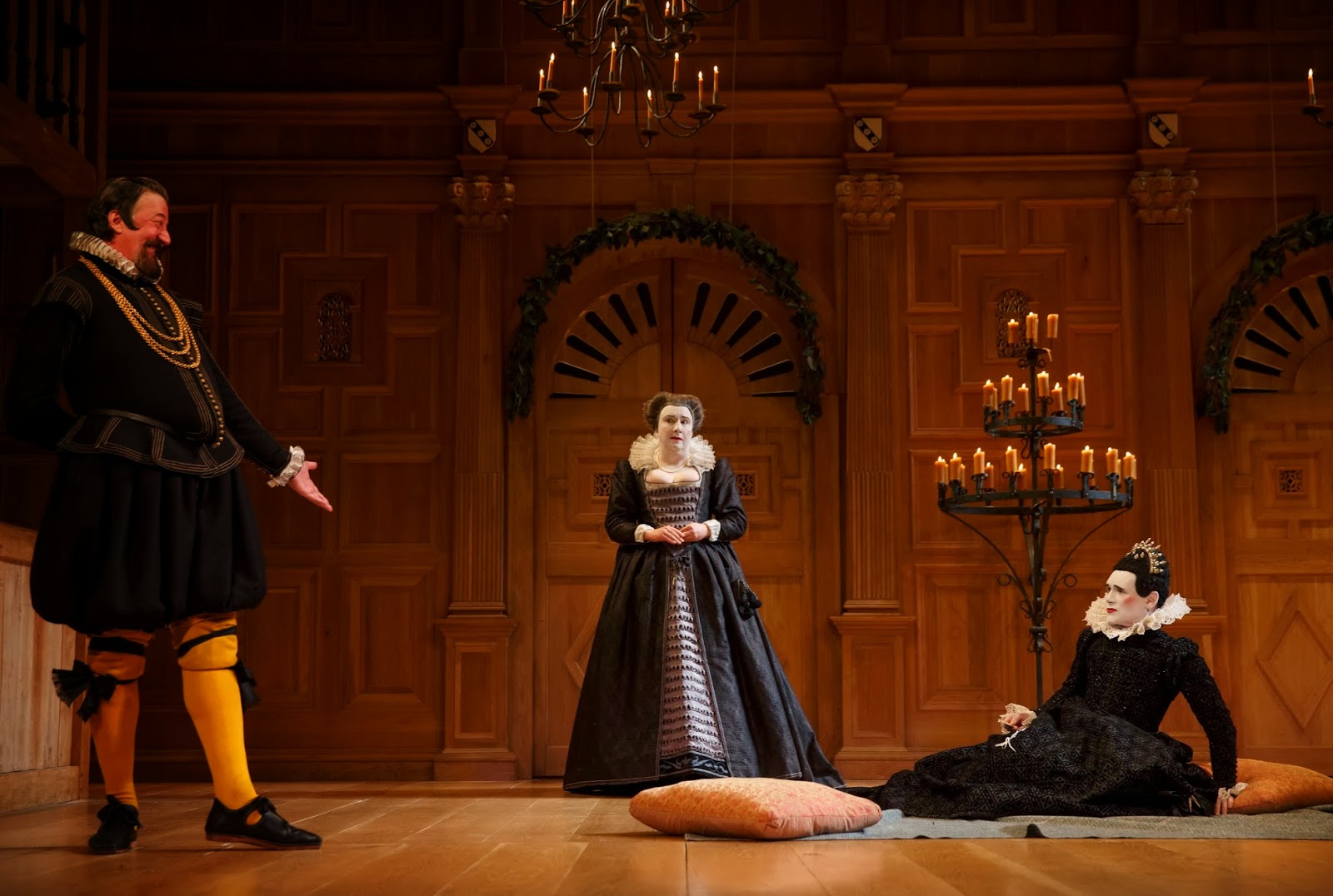
Twelfth Night
Tim Carroll, 2013

3. Quantum Leap Shakespeare: characters get teleported into another period altogether; Beatrice & Benedick execute their romance like they’re cursed to replicate their actions no matter where or when they are

Much Ado About Nothing
Jack O'Brien, 2014

4. Heavy Metal Shakespeare: rather than pinning down a drama to a specific era, the staging defines a generic medieval setting with fur ruffs, leather straps studded with metal, heavy percussion, and high dudgeon

Macbeth
Jack O'Brien, 2013

5. Picturesque Shakespeare: an expressionistic approach that aims at an artistic effect through visual spectacle and show-stopping moments; in shows following this method, actors tend to get absorbed into the backdrop

A Midsummer Night's Dream
Julie Taymor, 2013

These five* approaches work just fine for very casual theatergoers since they present some variation on what Shakespeare “should” look like. But I know plenty of folks who have given up on Shak, having no desire to see another J. Caesar with cell phones. I don’t blame them, & I know I’m nuts for going anyway—undiscerning gluttony is a hallmark of fandom.

But beneath the superficial styles, these approaches are even more similar. The verse is normalized to sound like speech rather than recited as poetry; the playing is driven by psychological motivation, normal behavior, and bits of stage business. The stagings steer away from outright artifice, erecting a fourth wall (except during subtlely formal moments involving clowns). They also get discomfited by the dramatic devices that don’t fit into a realistic, modern mold—the devices of bed tricks & rituals of recognition, the ceremonies and masques of court, the intrusions of fantastical and otherworldly beings. The dominant format for Shak is literal-minded mimesis, the conventions of American movies applied to Elizabethan dramaturgy. Sounds awful, doesn’t it?

The fundamental problem is that Shakespeare’s plays aren’t smooth. They switch styles within scenes (look at how the gears shift in the first scene of Lear, from casual aristo chit-chat to a formal court scene) and between scenes (Macbeth’s famous segue from Duncan’s murder to the Porter’s routine). Nor are they realistic. That should be obvious, since the characters speak in verse, but it doesn’t stop directors from trying to pretend the opposite.

So the moment that an actor opens his mouth to speak (or her, in Macbeth & All’s Well), he’s dispelled the illusion of realism. The tonal and structural shifts, the formal devices and plot tricks, the outdated codes and obsolete social structures all fight against its re-establishment. I believe the best way to blend the polyphony of Shakespeare’s style is to admit its artificiality and go from there.

* Before my time, a sixth approach had a minimalist style and its actors in everyday clothes. It had countercultural aims, & it’s nearly extinct.

-----

photos
R&J, Midsummer: Sara Krulwich
12N, Much Ado: Joan Marcus
Macbeth: T. Charles Erickson