Showing posts with label Macbeth. Show all posts

Thursday, September 21, 2017

Women on Shakespeare: Megan Bones on Lady Macbeth

Since most Shakespearean casts are male-heavy and even male-only, coverage tends to focus on men who create the work. Let's balance that out! We're wrapping up the second season of my interview series, Women in Shakespeare. I'm talking with the women who produce and perform Shakespeare and related work in New York City.

Megan Bones is one of three actors in Dzieci Theatre's Makbet. This radical staging invites the audience into a shipping container, where gypsies (or more properly, Romani) mount a wild, ritualistic version of Shakespeare's tragedy. Incidentally, the venue is managed by Sure We Can, a recycling center in Bushwick that provides a safe space for plastic & metal collectors to redeem their salvage, and encourage the arts and sustainable urban culture.

-----
Let’s start with your 3-actor Macbeth. What have been the practical challenges in staging this epic drama with such a small cast?

For Dzieci Theatre’s production of Makbet. I really have to be on my toes the whole time. Knowing all of the lines and being able to jump from character to character requires a specific demand, but that is the easy part. The true challenge for all of us is to be present to the moment at all times.

How has the play been reshaped to accommodate three actors?

In order to accommodate three actors, we altered the text quite a bit. For example, some of the minor characters and plot points have been cut from the play, a few minor characters have been blended together into one character, and some significant plot-related lines have been redistributed to a character who doesn’t normally say the line. We also cut huge portions of the dialogue to reveal the “essence” of each scene.

What roles do you play?

The actors in our Makbet have learned the entire text and we switch from character to character throughout the evening. We use specific props to signify each character. It is highly improvisational, so I never know at the top of the show when I will be a certain character. [But] each night I play every major character at least once (Makbet, Lady Makbet, a weird sister, and Macduff). I often play many of the supporting roles as well (King Duncan, Malcom, Lady Macduff, and a handful of messengers).

What challenges stem from this approach to performing?


While it is challenging to shift from character at the drop of a hat (literally), that is what makes it so fresh. The ever-changing nature of this production allows for different aspects of the characters, the play itself, my fellow actors, and myself to be highlighted and to unfold on an ongoing basis. It is transformative and thrilling and the play just gets richer and richer. I love how surprising it is every night. I love it when the cast is so attuned to one another and the whole thing just “clicks”. While it can be a wild ride at times, the simple, quite, honest moments, stand out the most, especially when the choice made by the actors is contrary to how one would stereotypically play that scene. A hushed battle scene can be so remarkable! But these favorite moments stem from an effort by the entire cast to approach each moment with honesty and to not fall into our habitual responses, or to forcefully try to repeat something that worked so well the last time. This work is the most challenging aspect of this production.

You get to play Macbeth! What insights have you gained about the character?


Makbet gets caught up in forces that seem beyond his control. He doesn’t realize until “what’s done is done”, that he had ever had the power of choice. But, haven’t we all been swept away or manipulated by something or someone that led us to take actions contrary to our perceived nature? Given the right circumstance, we are all capable of his deeds. The qualities these characters posses are in our DNA as humans. We are all Makbet. We are all Lady Makbet. I, too, could be swayed by the desire for power for wealth. I, too, could be capable of murder. So could you. So could any of us. That’s super interesting to me.

How has your social identity as a woman affected your approach to the role?

The fact that I am a women cannot be ignored and it is going to color everything that I do in Makbet. However, in approaching the role of Makbet, or in any role, my focus is less on my identity as a women, and more on what makes these characters universal. In this, I am not attempting to play “myself”, but I am using myself as a resource. If I try to “act like a man”, or if I am worried about being a women while playing a man, it feels and reads false. Any stereotypical behavior divides us from a deeper involvement to the mystery of human behavior. Instead, I focus on the actions of the character and his/her relationship with other characters. That’s something I can truthfully perform.

You’ve worked as a core member of the Dzieci ensemble for almost a decade now. What sets this company’s approach apart from more conventional Macbeths?

In every piece we do, we try to create a community. Makbet is no exception. When you arrive on the scene, you are immediately greeted as if you were a family member. We give you vodka, we give you kielbasa, we sing to you as we hang out by the fire.

But there are a few subtle things going on that also aid in creating this community. In each of our pieces have a “character/archetype” that is actually intended to provide a gulf between the audience and the performer. The characters we portray are outsiders. In the pre-show, the cast, already in this character, essentially says, “Here I am!” It is the job of the audience member to meet us, accept us and bridge that gap.

Who are those outsider characters?

In Makbet, we are a clan from the “Old Country” This clan is a performing a ritual. We take on the characters in Makbet and carry out the violence, revenge, betrayal, etc in order to purge these aspects from our community. The way the ritual is performed — three actors, switching roles, led by a chorus inside a shipping container — lends itself to the most unique Makbet you will ever see!

Talking about Shakespeare more generally, what’s your perspective on his roles for women? Where are his strengths in depicting them and where are his weaknesses? Is there anything in his plays that’s beyond salvaging?

With regard to women in Shakespeare, I think all of his plays are worth investigating. Sure, some may say that his women are not portrayed in the most positive light, but he was writing at such a different time. I don’t fault him for that. These characters are still deeply compelling. Shakespeare is such a master at writing to the human experience. If you take away the character name, and just read the lines… we have all experienced and felt what he writes about. It is what makes us the same, rather than what makes us different, that is appealing to me.

Do you have any other Shakespearean roles you’d love to play, or to go back to? Not just the women either—any dream-roles traditionally played by men?

Hamlet!

-----
Dzieci Theatre's Makbet plays from Sept 6 to Oct 8 at Sure We Can in Bushwick. Tickets are $20!
-----

headshot  
photos  

Monday, August 7, 2017

Women on Shakespeare: Jenny Strassburg on Lady Macbeth

Since most Shakespearean casts are male-heavy and even male-only, coverage tends to focus on men who create the work. Let's balance that out! We're wrapping up the second season of my interview series, Women in Shakespeare. I'm talking with the women who produce and perform Shakespeare and related work in New York City.

Firmly rooted by two decades of producing outdoor Shakespeare, the NY Classical Theatre stands out for its theatrically environmental stagings, which keep audiences on the move in Manhattan parks. In her debut with the company, Jenny Strassburg takes on Lady Macbeth. She emailed with me about the role, and about Shakespeare generally.
-----
Let’s start with Lady Macbeth. What have you discovered about her that you find fascinating?

I love that Lady M will change on a dime to get what she wants — the crown that she feels her husband deserves. For me, the most challenging scene is probably the incantation. It’s taken me a while to feel my way through that one, i.e. trying to find the truth of it. But after doing some research, I realized that this moment, and all of the supernatural moments in Macbeth, are akin to our modern-day special effects and therefore have a heightened theatricality. And really, Lady M herself has a heightened theatricality as well. She’s dynamic and dramatic. Once you can embrace that, it’s really fun to do as an actor.

What knots did the playwright leave for you to untangle?

There are lots of knots in Macbeth — the one I find most fascinating is the idea to murder Duncan. It’s not explicit in the script. In rehearsal, we were trying to figure out whose idea it was — Lady M’s or Macbeth’s. You literally have to read between the lines, and what we discovered is that it is an idea that they hatch together, almost without words. The Macbeth’s are so in tune with one another that they have the same thoughts at the same time, finishing each other’s sentences. They are the original power couple.

Who is she, independent of her husband? What drives her to commit murder?

When we first see Lady M, she is reading a letter where Macbeth tells her about his meeting with the witches and what they have forecast for him. If she had never received the letter, I believe that she and her husband would have gone on happily living together, very much in love. But she receives the letter and is then told that Duncan is coming to her house, which seems like Fate to her. And when Macbeth arrives the two of them start to plan.

She seems so incredibly strong and ambitious, the stronger of the two really, and it’s very interesting to me that when she realizes she has lost her husband in the banquet scene, she starts to lose her own grip on reality. So, in the end, being independent of her husband is so painful that she cannot go on living. And that pain is what drives her to suicide — and while she plots the death of Duncan, her own murder is the only one she actually commits.

How do you approach her mad scenes, and play them honestly? What, in your mind, links them to the sane woman earlier in the play?

I actually really like getting to play the mad scene. It is a totally different side of Lady M that we haven’t seen up to this point in the play. She is very vulnerable, and even has moments of returning to her childhood. Our director, Stephen Burdman, was incredibly helpful in crafting this scene. He told me that in order to play mad, you have to commit to each moment fully and then change on a dime. Shakespeare has written very clear beats in this scene, so that the actor knows when and where Lady M is in her head from moment to moment. There are actually very clear links to earlier moments in the play — she repeats some of the same lines, or a version of them, so that you know exactly what moments she is revisiting and trying to resolve.

What does Lady M share with similar roles in Shakespeare, like Cleopatra, Lear’s daughters, and Queen Margaret?

Like Cleopatra, she feels she is fated for greatness, and like Cleopatra the pain of living without her love is too much, so to end her suffering she takes her own life. It’s interesting to think about her similarities to Goneril and Regan, who are trying to take the control of the kingdom from their aging father. Duncan is not senile — but his kingdom is in turmoil. There is no doubt in my mind that Lady M thinks Macbeth would be a better king. He is the nation’s best general, and in order to get there he must have inspired great loyalty, love, and respect in his men, making him an excellent and natural leader. Lady M and Lear’s daughters are overthrowing the present rule for something they think will be better — themselves. Queen Margaret is frustrated with her husband for his weakness and his inability to rise to the occasion, and Lady M certainly experiences that frustration with Macbeth’s vacillations and inability to leave the past behind once he is king.

What sets her apart from those women?

Well, she is strong and ambitious in a way that is threatening to society. She is unabashed about what she wants. And it’s amazing to me that the reaction that Shakespeare’s audience had to Lady M is probably going to be the same for many people in a modern audience. Women like this are dangerous — they don’t accept societal norms and refuse to be boxed in. She goes for the jugular in a way that I don’t think any of his other women do, so that it’s easy to see her as a villain — she is referred to as the “fiend-like queen”. But, of course, I do not see her this way. She loves her husband passionately and wants the crown for him. That she gets to be queen is secondary.

Talking about Shakespeare more generally, what’s your perspective on his roles for women?

His roles for women are fantastic. They are interesting, complex, and usually very strong. There are nowhere near as many female roles as men, so the women that are in the plays are going to be very compelling and integral to the story. Even the less assertive female characters have a strength of conviction and nobility. He was writing women that had to be played by men, but the words feel very natural coming out of a woman’s mouth, which I think speaks to Shakespeare’s genius. To date, I haven’t really found any weaknesses. Perhaps only that I wish there more women in the plays :). And to me, there is nothing in Shakespeare that requires salvaging. Even a moment that seem unfinished or disjointed is always there for the a reason — and it is up to the actor to discover why it is there. 

Do you have any other Shakespearean roles you’d love to play, or to go back to? Not just the women either—any dream-roles traditionally played by men?

I’d love to play Cleopatra or Imogen. I have a child and I’d love to see a woman play King Lear — it would be fascinating to see to how making Lear into a mother would inform the relationship with the daughters. Also, Hotspur, just because he’s awesome.

Thank you for your time, and break a leg!

-----
NY Classical Theatre's Macbeth plays from Jul 30 to Aug 20 in Battery Park in lower Manhattan, and from Aug 22 to 29 in Brooklyn Bridge Park across the river. Tickets are free!

-----

headshot  Laura Rose
photos  

Monday, January 30, 2017

Women in Shakespeare: Kate T. Billingsley as Lady Macbeth

Since most Shakespearean casts are male-heavy and even male-only, coverage tends to focus on men who create the work. Let's balance that out! This is the second season of my interview series, Women on Shakespeare. I'm talking with the women who produce and perform Shakespeare and related work in New York City.

Frog & Peach was founded in 1996 by members of the Actors Studio. The company has focused on Shakespeare, supplying Off-Off-Broadway with a semi-annual regimen since 2012. This month, F&P take up residence at the new Sheen Center, just off the Bowery, with Macbeth. Kate T. Billingsley plays the part of Lady Macbeth, and emailed with me about the role's rewards.

Let’s start with Lady Macbeth. What have you discovered about her?

The thing I find most fascinating about Lady M is her tragically glorious arc from beginning to end. The audience never gets to see her before getting the news of her husband’s encounter with the prophesying witches. She starts with the letter, with the news. I’ve often thought about what she was like before getting this letter. What kind of life must she have had to have wanted to attempt to assassinate the king and become a monarch herself? What sort of world was this woman living in? What have her experiences with men been like? In what ways can I relate to her own feelings of ambition and control? She is hungrier for power than her husband and ultimately, the Lady is the one who pulls the strings behind his actions and is left tangled in the knots she has created.

Which scenes are the most challenging?

The most difficult scene for me is the “sleep-walking” scene. I say this because of what it demands of my body and psyche. At the end of each performance, if I am not completely wiped out, I have not done her justice. Another scene I find challenging is the murder scene. The change I have to make in a matter of seconds from before smearing the grooms with blood to after is something I work to go deeper with every night. It changes for her from that moment on and she is never the same again. There is always more to search for. That’s how big these characters and their stories are.

What else have you discovered about Lady M’s inner life?

Cracking open Lady M has been an enormous challenge. She is intimidatingly intelligent and full of energy. It’s as if she has this engine inside of her that is charging from the gate. She is daring enough to call on spirits to help her be bold and uncaring enough to commit murder. She is facile enough to be able to manipulate her husband into following through with the murder.

When it comes to the actual murder itself, she admits she cannot do it because King Duncan resembles her father as he lay sleeping. So instead she waits with bated breath as her husband does the deed. This is ultimately, where I believe the misogyny of the Elizabethan era falls into place. Because even though she evokes these evil spirits to fill her with “direst cruelty” so that she can kill the King, ultimately, she cannot follow through with the deed. She is still too filled with sentimentality to do it. So, instead, Shakespeare makes her an accomplice, but not the murderer. Therein lies the burn.


What drives her to commit murder?


I think what drives her is a burning curiosity to understand the vastness of her own power as a woman and partner in her time. Her husband relies on her and confides in her. How many hours has she spent waiting and tending to their manor while he is off in battle? There must have been a tremendous time of reflection and thought as to how she fits into the picture of climbing success. It seems to me she has battled the patriarchy her whole life and found a partner who understands the pains that came with her journey. The Macbeths both seem to have pasts in which they came together to save one another and truly rely on one another as equals. This seems very modern to me, as does her relentless ambition to dig herself out of the hole she started out in. The first step was marrying Macbeth.

How do you approach her mad scenes, and play them honestly?


I truly feel the mad scenes are subjective and every Lady M is different. I hope mine rings true. When she returns from smearing the blood and placing the daggers, she is forever changed. From that transition on, she is a different person. The night terrors begin and do not end. She is truly battling the fatigue and hauntings throughout the second half of the play, not to mention the crumbling demise of her husband and truest love. I feel she tries her best to save face as much as possible; to try to keep herself together, to keep her husband together. The ultimate failure for her is the loss of her husband’s mind and partnership, and the guilt she did not expect to have.

What links her end to the sane woman earlier in the play?


I feel these mad scenes all link back to the beginning. It’s as if the spirits she cries out to are teaching her a lesson as to why one shouldn’t play with the occult if they aren’t prepared for the consequences. When working with her madness, I focus on loss and I work with the physical effects of insomnia and the imagery of night terrors. Being a member of The Actors Studio, I have a psychological approach to all my characters and work a great deal with the sensory. 

Talking about Shakespeare more generally, what’s your perspective on his roles for women?

I think Shakespeare writes brilliant women. Their strength often lies in their intelligence: emotional and/or intellectual. They are often the whisperer in the protagonists ear, the strength behind the action of their male counterparts. They are often ruthless and sensual, cut-throat and demanding, lyrical and bold. He wrote dynamic women, many of whom are quite modern. I think his language is so perfect that I shudder to point out Shakespeare’s flaws. Sometimes, I do wonder: what if Lady M had committed the murder herself? But then, the story would be completely different.

Do you have any other Shakespearean roles you’d love to play, or to go back to? Not just the women either—any dream-roles traditionally played by men?

I played Goneril when I was younger and would love to play her when I am a little older. I would love to play Kate in Taming of The Shrew or Portia in Julius Caesar. And, now that I am working on Macbeth, I think to play Macbeth himself would be an incredibly fruitful challenge. His arc is just so epic and lush. I love the idea of a Queen Lear, like Glenda Jackson’s, when I am of age and have the life experience to fully understand the breadth of Lear’s deterioration. And of course, I could spend the next twenty years still trying to unpack the puzzle of Lady M herself.

-----

Frog & Peach's Macbeth runs from January 19 to February 12 at the Sheen Center for Thought and Culture in the East Village. Tickets are $25.


-----
headshot  Laura Rose Photography
photos  Paul Greco

Friday, October 16, 2015

Women on Shakespeare: Elisabeth Preston as Banquo

Since most Shakespearean casts are male-heavy (and some are male-only), coverage tends to focus on men who create the work. Let's balance that out! This is #2 in my new interview series, Women in Shakespeare. I'm talking with the women who produce and perform Shak and related work.

This month, the role of Banquo in Fab Marquee's Macbeth is Elisabeth Preston. This production has subverted the traditional hetero casting of Macbeth in a big way. Both Macbeths are gay males, Duncan is a queen, the witches are slaves. I also saw Preston in an all-female Restoration comedy in 2014, so I emailed with her to talk about about Shakespeare and gender onstage.
Preston (r) with Mel House
in Fab Marquee's Macbeth


What was your first experience with Macbeth?

The first time I read Macbeth was in high school, and I absolutely hated the text. It felt like a silly ghost story with witches, spells, Highland mists, war, murder, and a stage littered with dead bodies… your typical Shakespeare tragedy! Hence my aversion and avoidance of the play for years, until I was asked to participate in an evening of performances for the Actor's Equity Association promoting gender-blind casting. Rebecca Patterson, founder and artistic director of the Queens Company asked me to play Macduff, in the scene where he is confronted by Malcolm, the rightful heir of Scotland. For the first time, I understood the incredible nuances and subtle shifts of the play, the political powers at work, and the humanity that can be revealed when a person is left with no other options but to fight for their life. When I saw that Tom, Antonio, and David were producing a non-traditional casting of the show, my heart absolutely leapt. I knew I had to challenge my fears, suppositions, and knee-jerk dislike of the play and give it a second chance.

Can you tell us more about the non-traditional casting?

This production intrigued me because they made a male role a female one instead. By virtue of changing the gender, the relationship, words, and moments between she and Macbeth open up to possibility. In the original text, Banquo is a Lord of Scotland who fought valiantly side-by-side with Macbeth. They are men who experienced the unspeakable horrors of war together, a camaraderie that is profound—making [Macbeth's] betrayal of Banquo that much more poignant. This relationship is still intact when Banquo is a woman, but in light of our modern military system, I found the construct of a woman fighting valiantly alongside an openly gay man quite intriguing given sexual harassment against women and the history of Don’t Ask Don’t Tell.

Preston (r) as a libertine
in the Queens Company's Sir Patient Fancy
I saw you a few years ago in Sir Patient Fancy with the Queens Company. You played a rake in that show, and here you play Banquo, a warrior. Have you played any other male roles?

I've played men several times, and oh how fun it is to wield a sword! When I play a man, I enact a handful of physical gender cues that help ‘sell’ the gender switch. I’ll pitch my voice down, keep a wide stance, and do the NY subway ‘man spread’ when I sit. Aside from those cues, I focus on the words and story, making it clear and heartfelt. In this way, my hope is that audiences are able to see the common human experience, which is something that transcends gender.

Do you have any particular Shakespearean roles you’d love to perform—male or female?

Oh they’re all so good. Can you imagine performing the entire canon, and saying all of Shakespeare's words?! Is life long enough and could opportunity provide?! What an insight into humanity that would be…

How do you feel about training to play Shakespeare?

Training is not necessary to love, enjoy, or perform Shakespeare, but education (via life or academia) helps to unpack and enrich the experience. I knew that if I wanted to make a living performing, I'd need a little help. After getting my undergraduate degree in Theater at the University of Kansas (special thanks to Paul Meier), and an MFA from the University of Florida State Asolo Conservatory, I was better equipped to be a more resonant artist. And that's all I've ever sought to do: speak Shakespeare's words with resonance, clarity, and truth. It's surprising the amount of work it takes to stand on stage and tell the truth in front of an audience.

Preston (r) with Antonio Minino
in Fab Marquee's Macbeth
Shakespeare has some—let’s say ‘problematic’ views about women. This play, for instance, paints powerful women (Lady Macbeth) and sexual ambiguity (those bearded sisters) in dark tones. How do you try to reconcile his 16th-century depictions of women with your 21st-century views?

The canon is certainly a reflection of its time, and reconciling his views (a mirror of his society) with our contemporary views is easy. He wrote incredibly smart and funny women like Beatrice and Rosaline, those women existed then and they do today. He wrote politically persuasive and sexually powerful women like The Princess of France and Cleopatra. He wrote Desdemona, a women accused of infidelities she didn't commit and she was killed for it. All of this is a reflection of the place of women in society then, and is still an accurate reflection of women around the globe today. So while the sexual ambiguity of the witches may be painted in dark tones, this is a reflection of how his (and our…) society view ‘the other.’ So much has changed since his time, but really so much has stayed the same. His is the voice of the human experience.

-----

Fab Marquee's Macbeth (of the Oppressed) runs from Oct 8 to Oct 24 at the Theater at the 14th Street Y (344 E. 14th Street).

Photos
Macbeth  Michael Dekker
Sir Patient Fancy  Bob Pileggi


Friday, May 22, 2015

Review: Macbeth (Mobile Shakespeare Unit at the Public)

Macbeth
playwright  William Shakespeare
company  Mobile Shakespeare Unit
theater  The Public Theater

players
Rob Campbell, Keith Eric Chappelle, Jennifer Ikeda, Nicole Lewis, Teresa Avia Lim, Nick Mills, Daniel Pierce, James Udom

director  Edward Torres
set  Wilson Chin
costumes  Amanda Seymour
composer  Michael Thurber
Rob Campbell & Jennifer Ikeda
in the Mobile Shak Unit's Macbeth
Each season, with accessibility in mind, the Mobile Shakespeare Unit strips down a pair of plays and schleps them to under-Shaken New Yorkers—people in shelters, halfway houses, prisons. This rough, gritty Macbeth foregoes the light-footed theatricality and transparent acting of previous MSU work. Instead the company plays in an old-fashioned declamatory style that emphasizes verse over sense and relies on the rhythm to add momentum. A few actors have the resonant voices for this approach—Daniel Pierce (Duncan/Macduff) and Keith Eric Chappelle (Banquo) are particularly easy on the ear—but it cuts against the American style of realistic acting and is tougher for an audience to grasp.

Rob Campbell, in the lead, walks nimbly through Macbeth’s speeches, more of a pensive Hamlet-type than the warrior he’s described as being. Jennifer Ikeda is one of a handful of Shakespearean specialists in NYC but more likely to be cast as Lady Macduff than Lady Macbeth. So, cast as Lady Macbeth, she grabs hold of her opportunity. Her strong, militant portrayal galvanizes her husband and the production. More generally, the company is solid but aside from the witches and Banquo’s ghost, they find few openings to connect with the script or the audience.

The main displays of theatricality come during the witches’ scenes, where prophesies are backed by a scuzzy steel guitar. With its dynamic staging and brisk pace, the show is a little too lean to have its full effect. The speed obscures some fundamental moments, especially the warnings about woods and wombs. This Macbeth is the MSU’s first tragedy, and maybe it shows a limitation of the MSU’s format.
Rob Campbell with Keith Eric Chappelle,
Teresa Avia Lim, Jennifer Ikeda, & Nicole Lewis
in the Mobile Shak Unit's Macbeth
-----

The Mobile Shakespeare Unit's Macbeth runs May 17 thru Jun 7 at the Public Theater on Lafayette.
photos: Joan Marcus

Tuesday, September 23, 2014

How Not to Stage Shakespeare

Writing about deBessonet’s Winter’s Tale last week, I barely touched on Todd Almond’s massive contribution. Their Tale is a musical, less of a departure than Kiss Me Kate but still a radical revision. They retain whole scenes of Shakespeare, but they also supplement the speech with songs in a modern idiom as well as new dialogue. They recast Almond’s Antigonus as a second chorus, an MC whose post-mortum perspective (he’s the character who “exits, pursued by a bear” in Act 3) enhances the play’s melancholy. The device also links the polyphonic tones and styles of the original play with its musical, comedic, and choreographic additions. It’s the keystone to this Tale’s success.

I believe that polyphony is a fundamental element of Shakespeare’s dramaturgy. Not incidentally, I think it’s also the aspect that’s most often ignored, to the detriment of mainstream productions (& audiences!). There’s a lot of Shakespearean theater in NYC these days, but it’s pretty homogenous. The direction has narrow range of tone, a steady pace, and most importantly, a conceptual framework to give unity to the production. These approaches fall into a few conventional categories:

1. Modern Shakespeare: to underscore Shakespeare’s relevance, the director puts the characters in modern business attire (for a tragedy or history) or contemporary fashion (comedy, romance)

Romeo and Juliet
David Leveaux, 2013

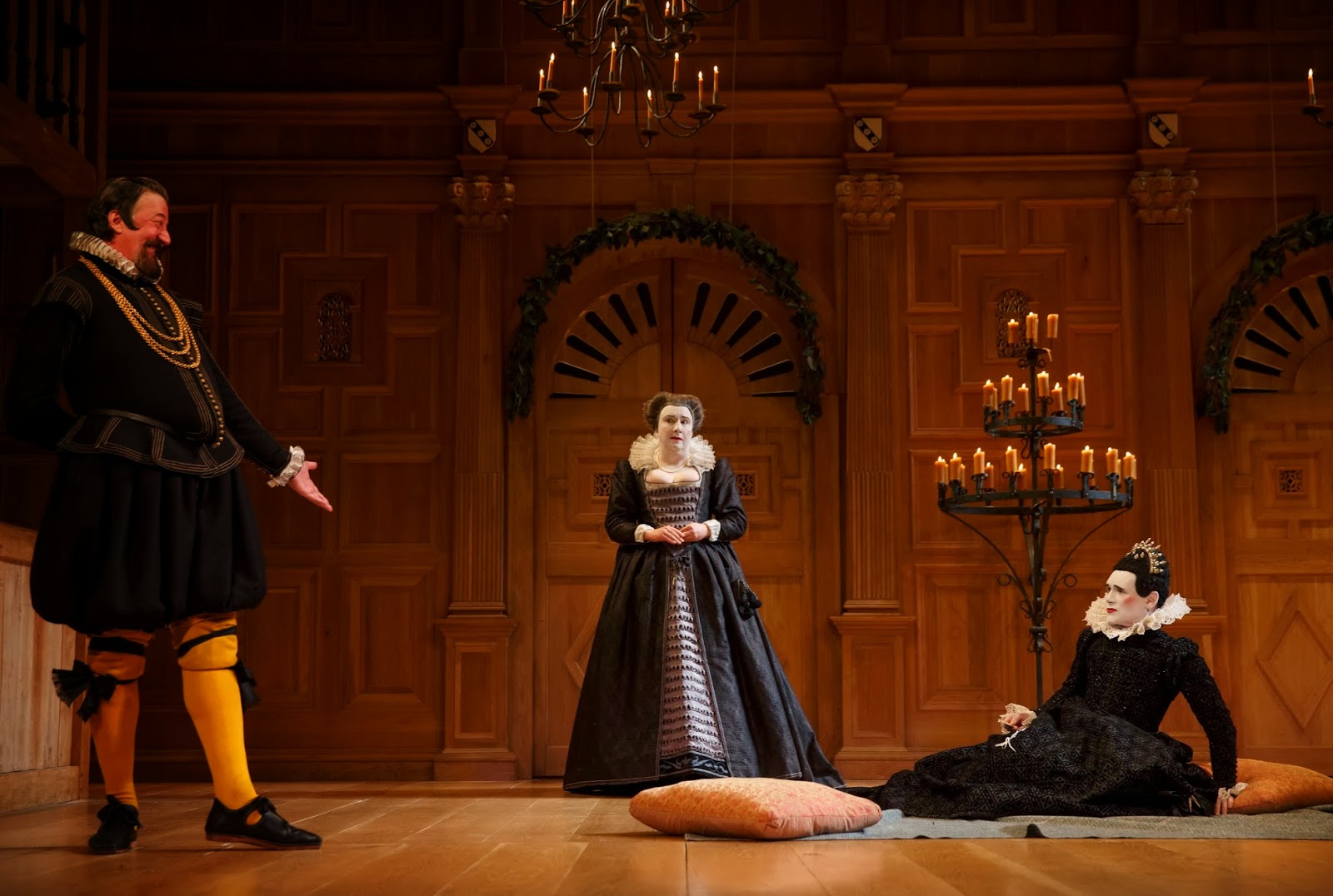
2. Retro Shakespeare: to keep faith with the plays’ cultural contexts, the production pulls out the doublets and hose

Twelfth Night
Tim Carroll, 2013

3. Quantum Leap Shakespeare: characters get teleported into another period altogether; Beatrice & Benedick execute their romance like they’re cursed to replicate their actions no matter where or when they are

Much Ado About Nothing
Jack O'Brien, 2014

4. Heavy Metal Shakespeare: rather than pinning down a drama to a specific era, the staging defines a generic medieval setting with fur ruffs, leather straps studded with metal, heavy percussion, and high dudgeon

Macbeth
Jack O'Brien, 2013

5. Picturesque Shakespeare: an expressionistic approach that aims at an artistic effect through visual spectacle and show-stopping moments; in shows following this method, actors tend to get absorbed into the backdrop

A Midsummer Night's Dream
Julie Taymor, 2013

These five* approaches work just fine for very casual theatergoers since they present some variation on what Shakespeare “should” look like. But I know plenty of folks who have given up on Shak, having no desire to see another J. Caesar with cell phones. I don’t blame them, & I know I’m nuts for going anyway—undiscerning gluttony is a hallmark of fandom.

But beneath the superficial styles, these approaches are even more similar. The verse is normalized to sound like speech rather than recited as poetry; the playing is driven by psychological motivation, normal behavior, and bits of stage business. The stagings steer away from outright artifice, erecting a fourth wall (except during subtlely formal moments involving clowns). They also get discomfited by the dramatic devices that don’t fit into a realistic, modern mold—the devices of bed tricks & rituals of recognition, the ceremonies and masques of court, the intrusions of fantastical and otherworldly beings. The dominant format for Shak is literal-minded mimesis, the conventions of American movies applied to Elizabethan dramaturgy. Sounds awful, doesn’t it?

The fundamental problem is that Shakespeare’s plays aren’t smooth. They switch styles within scenes (look at how the gears shift in the first scene of Lear, from casual aristo chit-chat to a formal court scene) and between scenes (Macbeth’s famous segue from Duncan’s murder to the Porter’s routine). Nor are they realistic. That should be obvious, since the characters speak in verse, but it doesn’t stop directors from trying to pretend the opposite.

So the moment that an actor opens his mouth to speak (or her, in Macbeth & All’s Well), he’s dispelled the illusion of realism. The tonal and structural shifts, the formal devices and plot tricks, the outdated codes and obsolete social structures all fight against its re-establishment. I believe the best way to blend the polyphony of Shakespeare’s style is to admit its artificiality and go from there.

* Before my time, a sixth approach had a minimalist style and its actors in everyday clothes. It had countercultural aims, & it’s nearly extinct.

-----

photos
R&J, Midsummer: Sara Krulwich
12N, Much Ado: Joan Marcus
Macbeth: T. Charles Erickson