Showing posts with label Much Ado About Nothing. Show all posts

Thursday, May 26, 2016

Women on Shakespeare: Anwen Darcy as Beatrice & Mercutio

Since most Shakespearean casts are male-heavy (and some are male-only), coverage tends to focus on men who create the work. Let's balance that out! This is #11 in my interview series, Women on Shakespeare. I'm talking with the women who produce and perform Shak and related work.

Nearly out on the streets a few years ago, Shakespeare in the Parking Lot has instead expanded to a 'second stage' in midtown, with Bryant Park Presents. The company has recast Anwen Darcy as Beatrice in its Much Ado About Nothing, after her acclaimed turn as Mercutio last summer. I emailed with Anwen about these two essentially Shakespearean characters.

Let’s start with your role in Much Ado. What makes Beatrice such a fully-realized character onstage?

Beatrice is one of Shakespeare's great women due to the fact that she's flawed. It's what makes her impossibly complicated and wonderful to play. She is, of course, witty and rambunctious and full of life. But she also has this corrosive edge to her, particularly in regards to Benedick. Add to that some of the best dialogue Shakespeare has ever written, and you have a woman who is more modern than most female parts written in the last 20 years.

Corrosive how?

You look at their first scene together, when he arrives back from the war, and she absolutely cannot sit on her disdain and pain at seeing him again. Of course, she also can't not talk to him, partly because she wants to humiliate him and partly because she wants his attention. That push and pull is fascinating, and it lends itself to be played thousands of different ways. You add in that she is hiding (very poorly, as the play lets you discover) a broken heart that still can't shake the breaker, and it all adds up to a fascinating starting place. Beatrice starts the show quite frosty, and I've found more you lean into how hard she is in the beginning, the more payoff you get at the end of the show.

I cannot tell you how satisfying that is, to just be allowed to be pissed off onstage without trying to qualify it. So often people try to soften women's anger onstage, to try and make sure you stay pretty and soft, and Beatrice is none of those things in the beginning of the show. She's just fine alone, but she knows she deserves more, and deserves to be loved for who she is without being changed. She's also had her heart stomped on (whether intentionally or not) by the only person she's ever deigned to show interest in, and Shakespeare lets her carry that. It doesn't go away once Benedick tells her he loves her—she distrusts him up until their final scene alone, when he tells her that he did challenge Claudio, and that he is actively choosing her over anyone else.

You've worked with your Benedick, McKey Carpenter, before. How does that help the onstage chemistry?

I'm exceptionally lucky in that not only have I worked with my Benedick before (this is our fifth show together) but I've also tackled Shakespearean barbs with him. McKey was the Tybalt to my Mercutio, so we have lots of practice hissing and spitting at each other. The difference is that this time we can let our affection and history with each other shine through.

I also think trust is a huge part of the wordplay of this show—because you have just have to unleash these torrents of dialogue at each other, you have to know that the other person is going to be there for you, both in scenes where you hate each other and the scenes where you love each other. The end of the wedding scene is a great example of this—Beatrice is finally fully unleashed, and she just has this righteous furious scream of mourning dialogue for Hero, for the death of men, for her inability to be of any help. Benedick has maybe five interjections in two pages, but he has to be there, in the scene, as fully committed as if the dialogue was bouncing back and forth. McKey's always there. You can't do one half of this show without the other.

McKay Carpenter & Anwen Darcy
as Benedick & Beatrice in Much Ado About Nothing
What strategies do you have for the wordplay?

One of the tactics we have in our arsenal for the warm up is a speed-through of all our scenes together. A lot of what makes Benedick and Beatrice so delightful is the speed at which they think up these terrible and hilarious insults. So we make sure that we are sharp on our cues and know precisely when to come in, where to cut a glance to the audience, when to move. We've also been known to run lines jumping up and down or mock punching each other, but that's mostly just because we both enjoy hitting things.

I can tell you that the best way to nail the wordplay is a vocal warm-up (which is important) or bouncing a tennis ball back and forth while we run lines to keep up a pace (very much not important or particularly helpful). But at the end of the day you need just need the right partner, otherwise you can never let go and just let the words guide you. 

Let’s talk about Beatrice & Hero. What have you discovered about their relationship?

Beatrice and Hero's relationship is the engine of the play. To me, Hero is Beatrice's heart—there is nothing in the world she wants more than Hero's happiness. You see it when Claudio and Hero get engaged—Beatrice is so excited she is answering for them, because she fully believes that her beloved cousin got her happy ending, and that's enough for her. She says "Good Lord for alliance! Thus goes everyone to the world but I, and I am sunburnt. I may sit in a corner and cry, 'Heigh-ho for a husband!'" which on its surface, seems a little bit like Beatrice is trying to steer the conversation back to herself. To me, this highlights not just how at ease Beatrice is with her lack of a husband, but how she views Hero. Hero is everyone in the world to her, and now that her world is safely in the hands of her beloved, thus can Beatrice return to her happy corner of the world, unworried by men or love.

It's one of the few female relationships in Shakespeare unfettered by any sort of jealousy. Hero genuinely wants Beatrice to get together with Benedick, Beatrice genuinely wants Hero to marry Claudio, and both women want that because that is what they know lies in the heart of the other woman. They are both driven by love, and that's fascinatingly rare—there are no ugly ulterior motives in the relationship.

Did you draw (or reject) from other Beatrices you've seen?

Carpenter & Darcy in Much Ado
I tried to watch as many versions of the show as possible once I knew I was cast and had strong ideas of my own but well before we started rehearsal. So my Christmas was spent watching other Beatrices and seeing what I thought worked, what I thought didn't, what cuts I thought were completely egregious. What struck me most was how a lot of versions I watched couldn't decide on what the show was, exactly. I think a lot of people have an abstract idea that "Oh, Beatrice is the funny one and everything should be played for a laugh." I know I made a very conscious decision not to try to be funny—which sounds ridiculous! It's a comedy! But this is a show where the comedy needs to be weightless and top itself, and the more comedic business you add on each line, the more stakes you add to that line, until suddenly you are watching all these Beatrices' trying to hit a home-run belly-laugh on every single line. And it is not only exhausting, but when you are fighting for a laugh, it obscures a fair amount of the beautiful language.

What about the movies?

I was, for many many years, entirely obsessed with Emma Thompson's Beatrice, and Emma Thompson herself. I am sure I have probably stolen more than I realize from her, but quite honestly, if you are going to accidentally be a poor copy of someone, at least be Emma Thompson.

I know many many people loved Joss Whedon's version, but I have yet to sit through it without screaming—it epitomized (to me) what happens when you remove the musicality and formality of the show, and it seemed to rob anyone (but particularly Beatrice, unconstrained by society or outside judgement) of specific stakes. I'm currently trying to find a video of the Janet McTeer/Mark Rylance Much Ado [London, 1993] as a closing night present to myself. I want to weep at their utter perfection when I no longer have to attempt to even use the same yardstick as them.

I’m interested in gender-bent casting, so I’d love to hear more about your Mercutio last summer. How did you address the gender swap onstage or in rehearsal?

Mercutio is a part that pretty much does all of your work for you, if you let it. He has surprisingly few scenes—I think there are maybe three major ones (four if you break the beginning of Act Three into two scenes), plus a cameo appearance at the ball. But I have never had people react to a character just walking onstage they way people do when Merc comes on. The audience is ready. They want you to be outrageous, they want to laugh.

How did you approach the role?

Anwen Darcy as Mercutio
in Romeo & Juliet (2015)
I remember when I got the offer to do Mercutio, the brief was just "Tank Girl in Verona". So I built on that, and very gradually it became apparent to me that Mercutio was male, regardless of what my sex was. Merc is a boy. So Romeo and Benvolio treated me like a man—I don't think we even wound up swapping pronouns in their lines because I was absolutely 100 percent male to them. So to us, it was still three boys against the world. It wound up affecting Tybalt more, I think—he was the only one who ever referred to me as female onstage, and it was only during the fight, so he was using it as weapon of sorts. So to the actors, we had a very specific roadmap of negotiating the sex change.

You know Sebastian Stan in the Captain America movies? Bucky Barnes as the Winter Soldier was the endgame, physically, for Mercutio. We just wanted there to be so much going on—hair, eye makeup, sais hanging off my hips, scuffed-up combat boots and jacket—that it hid any kind of distinct femininity and just switched into an aggressive sexuality. 

Did your gender alter the dynamic with your Romeo?

Romeo and Juliet has a very pronounced and vocal community of Romeo/Mercutio/Benvolio shippers (people who think that those characters are romantically involved, and in any and all ways that triangle would allow it to happen) so it was interesting to see how that affected people's perception. I certainly wasn't playing any romantic interest in Romeo, but lots of people commented on how they saw the romantic longing there in our scenes together. Whether or not that was because I was female or whether it's just because it's a very popular subtext in Romeo and Juliet commentary right now, I don't know.

Talking about Shakespeare more generally, what’s your perspective on his roles for women?

I think one of Shakespeare's great strengths in writing women is that he lets them be flawed, he lets them be whole messy people with internal engines and agendas. I think the problem you run into is that then he doesn't know how to reconcile that with the endings of his shows, a lot of times.

What do you mean?

Anwen Darcy as Beatrice
Look at Much Ado. Beatrice pretty much talks her way through every single scene she is in, regardless of the sex of the other people on stage with her. Then you hit the wedding. Beatrice has five lines in the wedding, three of which are some variation on "Hero, why are you falling down? Hero??" She briefly defends her cousin's honor, but it's one of the few times you see her immediately back down when confronted. Why isn't she talking? We know she has a lot of opinions and feelings about the situation—her explosion at Benedict in the next scene confirms that. But after the wedding, after the humiliation of Hero, Beatrice stops talking out of turn. She stops driving scenes. She surrenders the narrative entirely to Benedick, issuing him an ultimatum and then leaving. It's horrible! It's infuriating, because Beatrice is more than capable of cutting Claudio and Don Pedro down to size. But she doesn't—she defers to Benedick. So as a modern woman, that's infuriating. Beatrice has so much going for her, and it's dropped at the end of the show because she's in love and no longer needs to be complicated.

I see!

And that, to me, is the biggest flaws of Shakespeare's shows—once an intelligent and complicated woman has served her purpose, she stops talking. In Lady Macbeth's case, she dies offstage. OFFSTAGE!! She gets a couple of lines explaining her death, and that's it. So it's a challenge to motivate the sudden drop in your lines—why is Beatrice, a woman who talks so much that she is compared to a parrot—suddenly silent? I'm still a little mad at Will at that one. I don't think any of his plays are beyond salvaging, but I do think being mindful of the way women-of-agency are treated is very important.

Are there any particular Shakespearean roles you’d love to play?

Of course I have a Shakespeare bucket list. I've been very, very lucky because I've knocked a couple of dream roles—Hermia, Princess of France, Mercutio and now Beatrice—off very early in my career. I'd love to come back to Beatrice, maybe in ten years, just to see how differently I see her then. Cleopatra is next on my list—it's such a complicated play, and Shakespeare's Cleo is such a weird mix of romantic and deeply pragmatic that I really want to tackle it and just drive myself crazy. Titus is another one—I've wanted to play Lavinia for ages, because she's so important to the show and yet is completely silent for most of her stage time. As someone who is normally given pages upon pages of dialogue, I would really love the challenge of playing someone who is primarily onstage to project her internal life, and who can only communicate in limited physical movement. And I think Kate in Shrew has got to be on anyone's list. Just a chance to tackle that final monologue, to try and wrangle that beast into submission, is a challenge I think pretty much all classical actors have spent time thinking about.

Any dream-roles traditionally played by men?

In terms of gender bending—I am deeply jealous of any man who has ever gotten to be Henry V. I love that show, I love Henry, I love the whole leadup to his journey in Henry IV parts 1 and 2. I would probably do a lot of terrible, terrible things if you promised me that I could be Prince Hal.

-----

Bryant Park Presents and The Drilling Company's Much Ado About Nothing runs from May 19 to June 4 in Bryant Park. Tickets are free.

-----

headshot  Laura Rose
photos #2,3, & 5  Remy
photo #4  Josef Pinlac

Tuesday, September 23, 2014

How Not to Stage Shakespeare

Writing about deBessonet’s Winter’s Tale last week, I barely touched on Todd Almond’s massive contribution. Their Tale is a musical, less of a departure than Kiss Me Kate but still a radical revision. They retain whole scenes of Shakespeare, but they also supplement the speech with songs in a modern idiom as well as new dialogue. They recast Almond’s Antigonus as a second chorus, an MC whose post-mortum perspective (he’s the character who “exits, pursued by a bear” in Act 3) enhances the play’s melancholy. The device also links the polyphonic tones and styles of the original play with its musical, comedic, and choreographic additions. It’s the keystone to this Tale’s success.

I believe that polyphony is a fundamental element of Shakespeare’s dramaturgy. Not incidentally, I think it’s also the aspect that’s most often ignored, to the detriment of mainstream productions (& audiences!). There’s a lot of Shakespearean theater in NYC these days, but it’s pretty homogenous. The direction has narrow range of tone, a steady pace, and most importantly, a conceptual framework to give unity to the production. These approaches fall into a few conventional categories:

1. Modern Shakespeare: to underscore Shakespeare’s relevance, the director puts the characters in modern business attire (for a tragedy or history) or contemporary fashion (comedy, romance)

Romeo and Juliet
David Leveaux, 2013

2. Retro Shakespeare: to keep faith with the plays’ cultural contexts, the production pulls out the doublets and hose

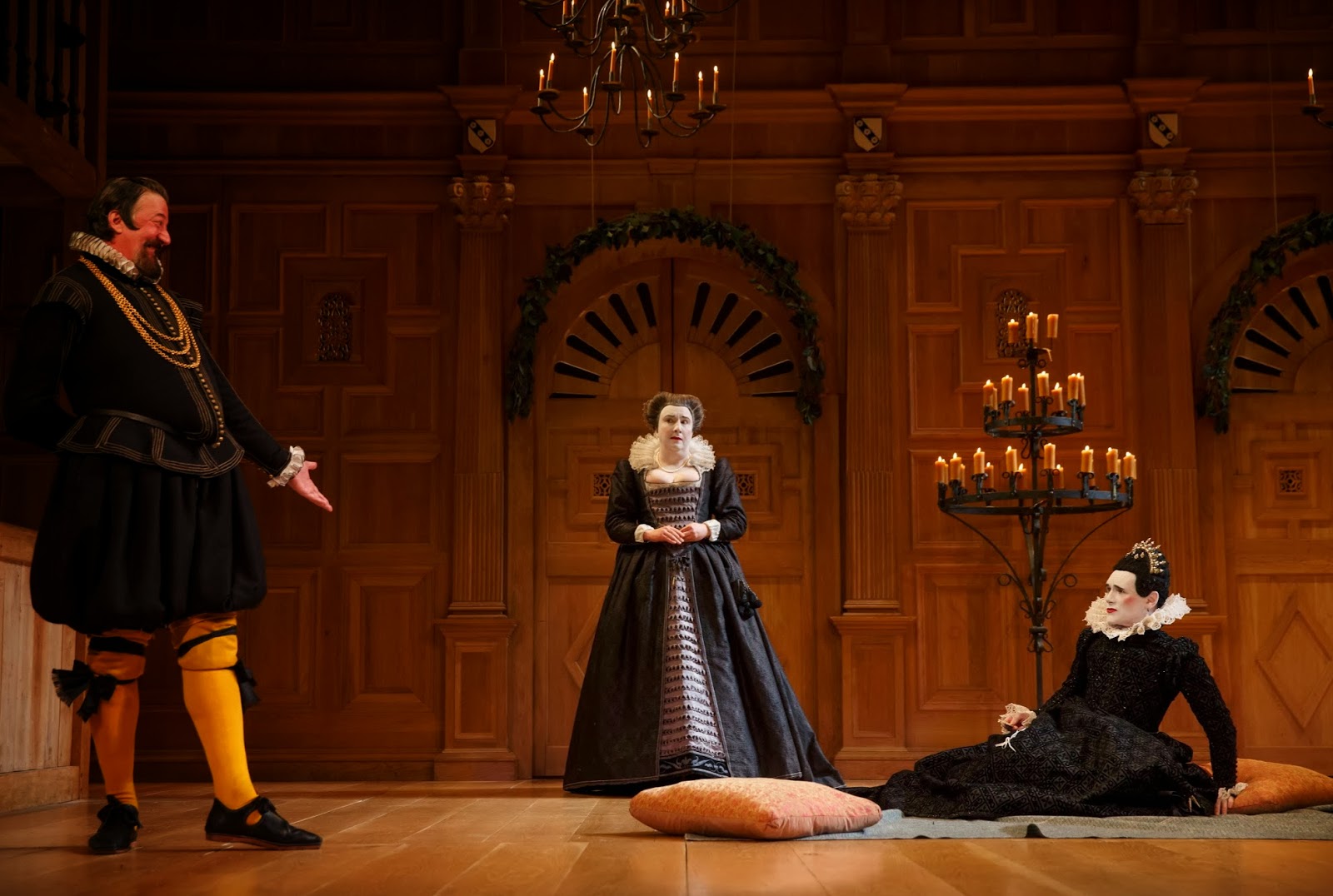
Twelfth Night
Tim Carroll, 2013

3. Quantum Leap Shakespeare: characters get teleported into another period altogether; Beatrice & Benedick execute their romance like they’re cursed to replicate their actions no matter where or when they are

Much Ado About Nothing
Jack O'Brien, 2014

4. Heavy Metal Shakespeare: rather than pinning down a drama to a specific era, the staging defines a generic medieval setting with fur ruffs, leather straps studded with metal, heavy percussion, and high dudgeon

Macbeth
Jack O'Brien, 2013

5. Picturesque Shakespeare: an expressionistic approach that aims at an artistic effect through visual spectacle and show-stopping moments; in shows following this method, actors tend to get absorbed into the backdrop

A Midsummer Night's Dream
Julie Taymor, 2013

These five* approaches work just fine for very casual theatergoers since they present some variation on what Shakespeare “should” look like. But I know plenty of folks who have given up on Shak, having no desire to see another J. Caesar with cell phones. I don’t blame them, & I know I’m nuts for going anyway—undiscerning gluttony is a hallmark of fandom.

But beneath the superficial styles, these approaches are even more similar. The verse is normalized to sound like speech rather than recited as poetry; the playing is driven by psychological motivation, normal behavior, and bits of stage business. The stagings steer away from outright artifice, erecting a fourth wall (except during subtlely formal moments involving clowns). They also get discomfited by the dramatic devices that don’t fit into a realistic, modern mold—the devices of bed tricks & rituals of recognition, the ceremonies and masques of court, the intrusions of fantastical and otherworldly beings. The dominant format for Shak is literal-minded mimesis, the conventions of American movies applied to Elizabethan dramaturgy. Sounds awful, doesn’t it?

The fundamental problem is that Shakespeare’s plays aren’t smooth. They switch styles within scenes (look at how the gears shift in the first scene of Lear, from casual aristo chit-chat to a formal court scene) and between scenes (Macbeth’s famous segue from Duncan’s murder to the Porter’s routine). Nor are they realistic. That should be obvious, since the characters speak in verse, but it doesn’t stop directors from trying to pretend the opposite.

So the moment that an actor opens his mouth to speak (or her, in Macbeth & All’s Well), he’s dispelled the illusion of realism. The tonal and structural shifts, the formal devices and plot tricks, the outdated codes and obsolete social structures all fight against its re-establishment. I believe the best way to blend the polyphony of Shakespeare’s style is to admit its artificiality and go from there.

* Before my time, a sixth approach had a minimalist style and its actors in everyday clothes. It had countercultural aims, & it’s nearly extinct.

-----

photos
R&J, Midsummer: Sara Krulwich
12N, Much Ado: Joan Marcus
Macbeth: T. Charles Erickson

Monday, June 30, 2014

Review: Much Ado About Nothing

Much Ado About Nothing
The Public Theater at Shakespeare in the Park
director: Jack O'Brien

FYI, an edited version of this piece appeared on NY Theater Review. I wanted a more complete record of the show, so I've decided to let everyone read the longer account! This version includes the effect of rain on the show the evening I saw it.

Lily Rabe & Hamish Linklater make as perfect a Beatrice & Benedick as you'll see,
despite (or because of?) their unorthodox choices
(photo: Joan Marcus)
The chemistry of Lily Rabe and Hamish Linklater, in their third collaboration onstage, makes a success out of a moody Much Ado About Nothing. Their Beatrice and Benedick are too clever, and have skin too thin, to let their guard down around each other. Linklater’s Benedick is an angry, edgy guy who craves attention; Rabe’s Beatrice half-regrets her own lack of interest in love. And when she overhears a list of her faults as reasons for Benedick to steer clear, this Beatrice sobs with self-reproach and emotional confusion. Rabe and Linklater imbue the air of the Delacorte with melancholy—even when one of them is dangling from a fruit tree—and add an emotional richness to Shakespeare’s comedy.

Building on these ironic performances of merry sadness, Jack O’Brien’s Much Ado shows his mastery of stagecraft and focus of vision. The few flaws detract a little, but are easily overlooked—especially given the perfection inherent in the Public’s Shakespeare in the Park. John Lee Beatty’s long stage offers several playing areas for O’Brien, primarily the terrace of a Sicilian villa, c. 1900, but also a balcony for Beatrice in her first volley with Benedick (a typically clever nod to another pair of Shakespearean lovers), a set of vegetable gardens, and a rather overused fountain. It’s both public and private, bustling with servants, ripe for eavesdropping and rumor. O’Brien also emphasizes the atmosphere of celebration, with masks and music imparting a ready friskiness to the household’s daily affairs.
For me, Mitchell singing "Hey Nonny Nonny" was the show's high point.
(photo: Joan Marcus)
But given its solidly realistic sensibility, the show’s few moments of enchantment seem incongruous (albeit lovely). Brian Stokes Mitchell harmonizes least with the show’s prevalent mode of playing. He plays Don Pedro with a hearty gusto and a sailor’s laugh, and with none of the psychology of Rabe and Linklater. Yet his participation in a round of “Hey Nonny Nonny” makes that misfit moot, and his skill at the verse and bass voice suggests great potential as a Shakespearean actor (as far as I can tell, the closest he's come has been his Tony-winning perf in Kiss Me Kate). His lusty 2D approach is complemented by his stage-brother, Pedro Pascal as Don John. Nearer to Linklater & Rabe's method is John Glover, an experienced Shakespearean, who makes a great role out of Leonato, especially in his grief at his daughter’s supposed infidelity. As for the sentimental lovers, Ismenia Mendes and Jack Cutmore-Scott fill their roles generically. More interesting is ZoĂ« Winters, who brings a sexy vivacity to the small role of Margaret, the duped accomplice in Don John's intrigues.

But this review comes with a caveat: the night I attended Much Ado, it drizzled all through the show. The weather’s effect on the show’s energy is hard to gauge, but it probably dampened the audience’s spirit at least. The actors never lost their focus but some adapted to the circumstances better than others. John Pankow, as Dogberry, effortlessly upped the tempo to his schtick, as if he were ready to skip the curtain call and meet us at the alehouse. Scenes like Claudio’s ceremony of remorse for wronging Hero, on the other hand, probably would’ve been stolid even on a lovely night.


Best of all, however, was Linklater’s casual “whoop, that’s wet” as he sat on a chair, mid-soliloquy—the biggest laugh of the night, until Rabe entered and perched herself onstage to chat with him. She winced too, and only then noticed Linklater’s warning gesture. The tart, ironic charm of her invitation to sit with her, and his disgruntled acceptance, epitomized their interpretations of the characters. It was a perfect you-had-to-be-there moment of spontaneous theater.
I'm not a fan of realistic sets in Shakespeare—they tend to muddle the location
rather than clarify it—but Beatty's design is lovely
(photo: Joan Marcus)

Wednesday, June 11, 2014

Shakespeare's Sisters

"As a contemporary woman in New York City, it's hard to empathize with a girl who is as compliant, dainty and well-behaved as Hero. I've had this issue when watching other actors perform her as well—here you a have a modern woman, Beatrice, essentially behaving as a man in a man's world—and there's Hero next to her: she's quiet, obedient, and for most women today, absolutely infuriating."


Hero (Ismenia Mendes, center) is always chaperoned when she's near a window
(photo: Joan Marcus)
That’s Ismenia Mendes, who I interviewed for New York Theater Review. Mendes plays Hero to Lily Rabe’s Beatrice in Much Ado about Nothing this month in Central Park. Shakespeare’s other show in the Park is yet another King Lear, to star John Lithgow. But I’m more curious to see Annette Bening and Jessica Hecht as his bad daughters, Goneril and Regan.

Shakespeare wrote several plays with great sister dynamics. In tragedy, the sorority is usually a triad: Lear’s three daughters, the trio of Desdemona, Emilia, and Bianca, and (of course) those Weird Sisters. In comedy, the relationship is a binary one, and it’s one of his earliest relationships, starting with Kate the Shrew and her devious sister, and continuing through to Rosalind and her faithful Celia. You could even look at Twelfth Night’s relationship between Viola and her mistress as Shakespeare’s final, kinky word on the subject.

The girls are usually sisters or cousins, both lacking a mother (in Love’s Labor’s, they’re a courtly quartet, a real sorority). Early in Shakespeare’s career, the girls are sometimes inadvertent rivals (Two Gentlemen, Midsummer), a complication that tests their love for each other. In other variations, one girl is modest and the other is saucy (Taming, Love’s Labor’s), a conflict of personalities that allows Shakespeare to contrast methods of wooing. Much Ado drops the first conflict to focus on the second, and I think it’s the acme of this sister dynamic.

Like Mendes points out, Hero can come across as bland on her own. She’s a medieval figure, the Virtuous Maiden, passive and obedient, a girl who exists solely as a unit in marital brokerage. She’s idealized by the men, who describe her as as “gentle,” “modest”, and (repeatedly) “fair”—a generic set of epithets. Even in 1597, Beatrice was more modern and more interesting. But Hero isn’t merely a docile foil for her tart cousin.
Hero (Ismenia Mendes) finds her main defender in Beatrice (Lily Rabe).
Are you going to argue with her?
(photo: Joan Marcus)
What’s great about Hero and Beatrice is that they have such different personalities yet they’re so deeply fond of each other. Beatrice teases Hero about marriage, and Hero, maybe acting out of sentiment or maybe in retaliation, gulls Beatrice into a romance. And no matter how roughly an actress plays Beatrice, it’s tempered by her love for Hero. In one of Shakespeare’s best scenes ever, her sisterly love inspires Benedick to challenge his best friend to a duel of honor. Hero may lack Beatrice’s vivacity but she has Beatrice’s trust. There’s even a bit of Beatrice in Hero, when she flirts nimbly with Don Pedro at the masque. We might wish she was more like her cousin, but I think she’s more vivid a character than she’s given credit for.

Thursday, May 29, 2014

Interview: Ismene Mendes as Hero

For some people, summer only begins when the Public Theater's Shakespeare in the Park starts its run. That's definitely the case for Ismenia Mendes, who makes her Delacorte debut on Tuesday as the innocent Hero in Much Ado About Nothing. This recent Juilliard grad has already worked Off-Broadway at Playwrights Horizons, the Flea, and Clubbed Thumb. NYTR editor Aaron Grunfeld spoke with Ismenia about her views on Shakespeare, acting, and her rehearsal process.

Ismene Mendes (r) with Jack Cuttmore-Scott
rehearsing Much Ado About Nothing

Have you seen or performed in Much Ado before?

Much Ado was actually the first Shakespeare play I ever performed in—I played one of the watchmen when I was in high school! I recall having given the character a horrendous cold.

Could you tell us something about Hero? What’s the most difficult facet of the role? How do you handle your character’s reconciliation with her fiancĂ©?

The trickiest thing about playing Hero is actually understanding her and loving her. As a contemporary woman in New York City, it's hard to empathize with a girl who is as compliant, dainty and well-behaved as Hero. I've had this issue when watching other actors perform her as well—here you a have a modern woman, Beatrice, essentially behaving as a man in a man's world—and there's Hero next to her: she's quiet, obedient, and for most women today, absolutely infuriating. I'm finding that the trick is not to fight against what Shakespeare has written but to really inhabit it. I can't be concerned with an audience's (or my own) prejudices toward her.

As to how I handle the reconciliation with Claudio at the end—I don't know yet. I'm starting to think Hero doesn't know either.

What’s your background in Shakespearean acting? Do you believe training is necessary to play Shakespeare? Do you have any particular Shakespearean roles you’d love to perform?

I was recently a student at Juilliard and was fortunate enough to receive a pretty spectacular education—but no, I don't think formal training is "necessary" to perform Shakespeare. That being said, however you acquire it, I do believe that knowledge of the text, verse, pentameter, etc is paramount—Shakespeare pretty much gives you a map, if you know how to read it.

Are there any particular roles in Shakespeare you’d love to do?

I would love to play Juliet in Romeo and Juliet, and Perdita in The Winter's Tale. Those are definitely at the top of my "in the next 5 years" list.

You’re working with Jack O’Brien, who has a long and successful record with Shakespeare. Did his approach to Much Ado introduce you to new methods of performing the work?

Yes! Jack is incredibly curious—he's not interested in preconceived notions, planned work or character choices made in the first week. I walked in the first day thinking I knew exactly who Hero was, but as of right now she is unrecognizable from who I first thought her to be. It can be really quite intimidating (and frustrating) to keep yourself in a state of 'not knowing'—but ultimately, it makes for a far more specific and truthful character.

Much Ado offers roles for a remarkable range of ages, with Hero being one of the youngest. What tips have you picked up from actors like Lily Rabe and Hamish Linklater, or from John Glover and Brian Stokes Mitchell, with their varying degrees of experience?

I'm pretty shy—and I find that I learn the most when I sit quietly and watch them at work. It's hard to put into words actually… It's pretty overwhelming, in a deep and humbling way. One thing that immediately struck me in the first week is how individual and unique they each are in their process. There really is no one, "best" way of getting to the heart of a character and play—each of them is so extremely different and brilliant in their own process.

Let’s talk a little about Shakespeare in the Park. What shows have you seen at the Delacorte over the years?

I've been coming to The Public’s Delacorte Theater since high school, but some of my recent favorites were The Merchant of Venice and Twelfth Night. People line up all night for a reason—I've seen some incredibly inspiring work up on that stage. Working here for the first time is a dream come true.

Have you done any outdoor theater before? What are you looking forward to or apprehensive about?

I haven't, and I think I'm most terrified of dancing in a corset in 90 degree weather while mosquitoes attack me.

Along the same lines, the Delacorte is a huge house. How do you prepare for such a large audience? How do you expect the size to alter your approach to performance?

Well, there's the size—but there's also the thrust stage. It forces you to be a smarter, more aware actor…. Warming up helps too.

Ismene Mendes (l) with Jack Cuttmore-Scott
rehearsing Much Ado About Nothing
Off-Broadway, Ismenia Mendes has played Bernie in Your Mother's Copy of the Kama Sutra at Playwrights Horizons and Peggy in A.R. Gurney's Family Furniture Miracle with Clubbed Thumb at the Flea. Since training at Juilliard, she has also played Katharine and Boy in Henry V at Two River Theater.
-----
The Public Theater’s free Shakespeare in the Park production of Much Ado About Nothing will run June 3 through July 6 with an opening on Monday, June 16.
-----
This interview originally ran on New York Theatre Review
-----
photos  Tammy Shell