Showing posts with label Theater for a New Audience. Show all posts

Monday, February 10, 2020

Review: Timon at TFANA

Timon of Athens
director  Simon Godwin
company  Theater for a New Audience

Timon of Athens is at the periphery of Shakespeare’s canon, a late-career collaboration with Thomas Middleton that reads like a rough draft. Its unfinished condition should make it a favorite of directors who like to stamp their visions on the classics. Yet Timon has only been staged twice in my 20+ years in NYC; it’s a treat just to glimpse it in the wild. 

Besides, the subject is timely but timeless: avarice among the rich. Timon, a patrician in classical Athens, spends money charitably but recklessly until it runs out. Bankruptcy sends Timon into the wilderness as a vagrant; buried treasure is a stimulus for invective rather than redemption. Finally the self-exiled pauper supports a general’s assault on Athens and then expires with a curse. Thematically & tonally, the play is a forerunner of modernism, with its alienation & disillusion, and its visions of the corruptive nature of capital. Like other late plays by Shak, it experiments with allegory & parable at the expense of plot & psychology. 

Simon Godwin, now in charge of the Shakespeare Theater Company in DC, directs this co-production between his company, the RSC, & TFANA. He’s cut & shaped the text considerably—sometimes radically—to make it stageworthy, but he & dramaturg Emily Burns have retained the character of Shak’s collab with Middleton. The staging is typical for more forward-looking companies, lively & modern. When soliloquies play in the foreground, the action upstage turns silent & slow-mo; three repetitious scenes of aristos snubbing Timon are collapsed into a montage. These devices heighten the play’s setpieces and render the underfleshed plot into compelling theater. 

The major rewrite involves that general’s assault on Athens. In the original it’s an act of treachery, like Coriolanus’ march on Rome. In this staging it’s an insurgency, a mobilization of leftist protesters. Early in the play, the general says, in lines written by Godwin & Burns:
“The dispossessed without the city walls make their abode…
No roof, no comfort, no hope of citizenship
No home, no country, they have abandoned hope.” 
In this tragedy, Timon’s suffering and death is a sacrifice to the spirit of economic justice. 

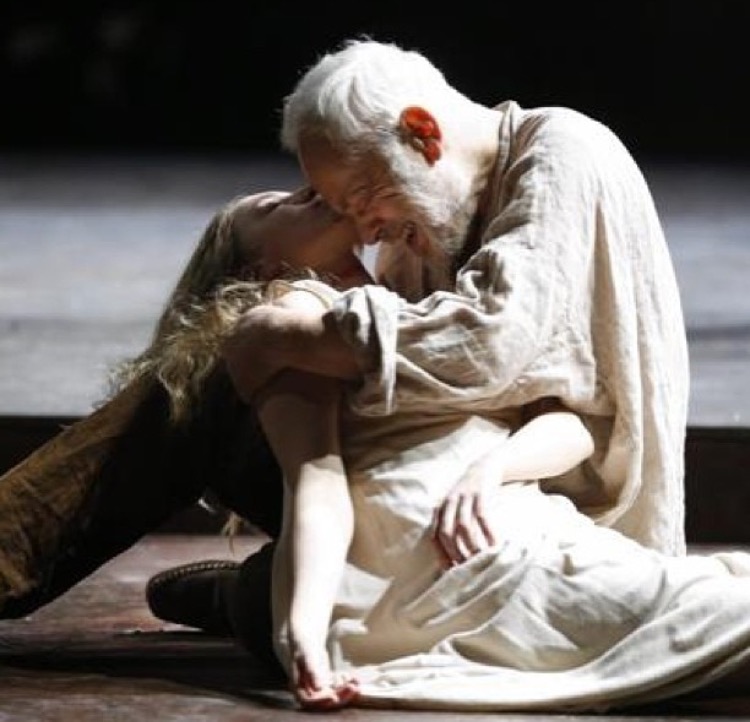
Almost incidentally, Timon and the general have been recast as women. It’s not to any thematic or theatrical effect, except the straightforward values of progressive casting. It gives a great actor, Kathryn Hunter, the chance to play a traditionally male role. The pronouns are changed but the part itself is sexless; Timon begins the play as a modern society matron, a thrower of dinner parties, and ends in filth & burlap. Hunter holds together the role & the show by force of personality. Her elfin face belies her remarkable presence, and her small stature contains the physical strength of a gymnast. By the fifth act, her reflections on human nature are filled with anguish, elevating the sense of tragedy to Lear-like proportions. 

As with many of Shak’s plays, the first half of Timon is stronger than the second. The city of Athens is presented in Oriental minimalism: black outfits gilded with gold, a live klezmer band, a bare brass wall with an empty black entrance. The wasteland of the second half is austere, the stage covered in dirt, and the action more fable-like. This shift of tone pays off when three bandits show up, intending to steal Timon’s treasure. Instead they’re treated to a mournful lecture on the wealth, and moved to quit thieving forever. The conversion of these clods is original to Shak, and it sounds a strange note of redemption. It’s the diamond in this play’s rough, and TFANA’s Timon presents it without a flaw.

Friday, June 16, 2017

Women in Shakespeare: Cara Ricketts on Isabella

Since most Shakespearean casts are male-heavy and even male-only, coverage tends to focus on men who create the work. Let's balance that out! This is the second season of my interview series, Women on Shakespeare. I'm talking with the women who produce and perform Shakespeare and related work in New York City.


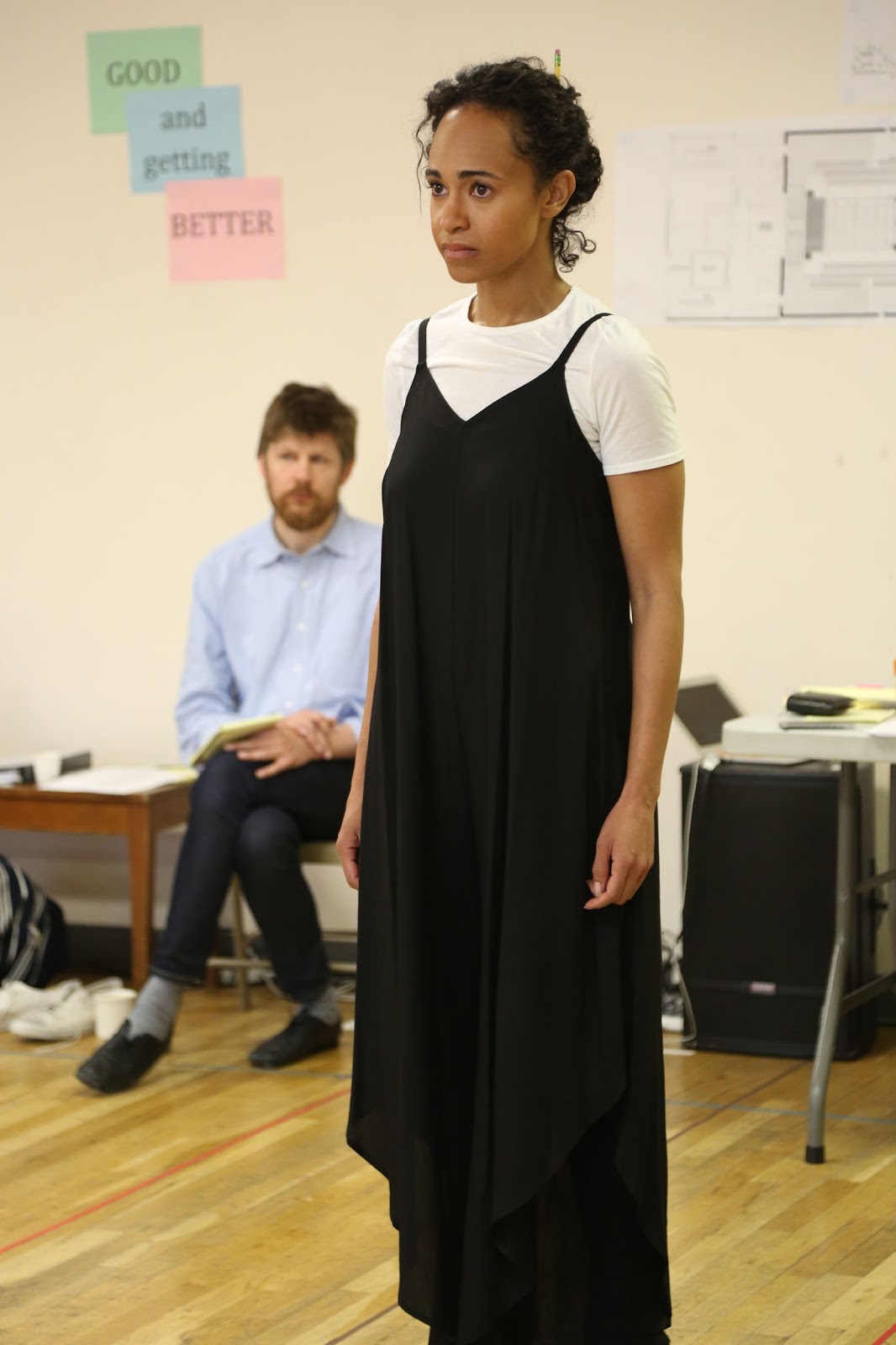
This summer, Cara Ricketts plays Isabella, the nun thrown into a moral quandary in Measure for Measure. The production, at Theater for a New Audience, is directed by Simon Godwin, whose gender-bent Twelfth Night last winter was the talk of Shakespearean London. Ms. Ricketts has earned notice in Ontario, where she's played Portia, Imogen, and others onstage at the Stratford Festival. I emailed with her about her role in Godwin's NYC production.
-----

Let’s start with Isabella. What have you discovered about her that you find fascinating?

Isabella, like all the ingenue roles in Shakespeare is not soft or weak or innocent. Isabella is a young woman with strong ideas that she truly believes in. As her story progresses in Measure for Measure she is forced to review her own personal laws to see if they still hold under the special circumstances that the play takes place. Not only does Isabella face these problems head on, she fights them, battles them to a death and looks for support.

Which scenes are the most challenging?

The scene that is most challenging is the Angelo scene. I'm fortunate to be working with Simon and Thomas who were will to listen to me and the other women in the room (stage management and assistant director Emma) as we discussed what it's like to be sexual harassed or assaulted as women. To explore that scene with the discussion we had and the viewpoints shared really opened the scene in a way that I hope the audience will be affected by. We were interested in telling the story of a woman put in that position truthfully.

What knots did the playwright leave for you to untangle?

What knots did Shakespeare not leave for me to untangle? Ha ha! I enjoy Shakespeare for that reason. I feel that there are hints in the text that can tell you a lot. The journey for me in rehearsal is to Nancy Drew the script until shows what I need to perform it.

I think one of the play’s themes involves Isabella’s autonomy. As an actor, how do you feel about the choices she makes in the play, and the ones taken out of her hands?

Isabella has fallen out of love with Vienna, for quite some time. She has decided to remove herself from it and devote her life to prayer. She enters the Poor Clares cloister which means she will have little to no contact with the world save for her fellow nuns. But she's about to dedicate her life to God and prayer and thoughts.

Isabella made the choice to not be a part of Vienna and immediately Shakespeare says no and throws her into the muck. Isabella doesn't want to play from the very beginning but her love for her brother pulls her in and dunks her in to the very world she is trying to avoid. I believe that it is not until Act 5 that she makes a choice that is not out of necessity. All her choices in the play are in service for her brother, she might think that she would give her brother up for her honor, but her actions speak the opposite.

What’s her role in the play’s action?

Her role in the plays action is Mercy. She begs for it and commands it only to later be asked for it from her enemy. If the Duke is Justice, Isabella is the other half that will bring the grace necessary to make Vienna right. It's why he asks for her hand, the Duke sees something right in Isabella to rule his dream for a new Vienna.

I read that you played Hedda Gabler in Toronto — does she have a kinship with Isabella?

Hedda is so much fun because she is a woman who makes decisions that people don't agree with. Especially as a woman people will want to tell you how to handle things or expect a certain kind of reaction. If Hedda had been a man there won't have been much of a play. Isabella has the same hurdle to overcome or rather ignore. She makes the decision after weighing her chastity to her brother's life and a lot of people judge her for that. Isabella is closer to someone like Lady M in that she is persuasive and she is good at it. Isabella is a force to be reckoned with and I believe this appeals to Angelo in that she is able to debate with him and keep up. Viola had to dress up like a man to exist in a man's world, Isabella dares to go as herself.

Turning to the play, what does Measure for Measure offer audiences that Shakespeare’s more famous plays don’t? Why is it a good play to revive now?

This is my first time working on Measure. It's interesting because it's a Shakespearian comedy, I believe one of his last. In Measure I can feel him stretch the genre as far as it seems to be able to go. At any moment if feels like it's going to be a tragedy but somehow it snaps back with the comedy ending of marriage and hope.

The ideas in this play ring to me, almost more than the characters. There is a meditation on death, then life and the play has such darkness and yet ends with forgiveness. So many times I find myself wondering "would I do that if I was in that situation?" It's a modern play in that way, it's very easy to see it as a play about those big ideas and it asks us to consider what we think of them: justice, and more importantly forgiveness. I read that Measure for Measure was first performed as part of Christmas celebration and I love that idea. On the birthday of the Jesus who died for our sins is a play about forgiveness.

It's a problem play in the old sense (defined by F.S. Boas) that we are looking at social problems and moral dilemmas. the problems and dilemmas are the same ones we face as a society today so the play has an impact. It asks the right question when we live in a time were we feel that society is divided.

Ricketts as Hedda Gabler
at Necessary Angel in Toronto, 2016
Talking about Shakespeare more generally, what’s your perspective on his roles for women?

What I like about Shakespeare is that his characters have universal journeys. Every once in a while something will ring out to me… lines like "a rich jewel in an Ethiop's ear" but he also wrote Othello and Aaron the Moor as two different men. It's remarkable that he wrote such parts about women when he didn't have women to play them. I think the reason why so many of his female characters run out to the woods dressed as boys was so that the boys playing girls could act more freely once they ditched the dress.

Where are his weaknesses in depicting women?

I think my biggest complaint would be how he goes on about pale beauty, I know it was the rage at the time but it's kinda boring now don't you think? Shakespeare knew too, hence the 'Dark Lady' sonnets. Ha!

Do you have any other Shakespearean roles you’d love to play?

I never have parts that I wish to play. I never really understand the parts until I'm in rehearsal and I appreciate the life that other actors create when it comes to playing Shakespearean roles.

What about one of the traditionally male roles?

I think if I were to play a man's part I would like to feel what Hamlet goes through. To break down that text and peer into the engine of that part. Maybe King Leontes in Winter's Tale. I would like to play a male role at some point, just to feel it.


-----


TFANA's Measure for Measure plays from Jun 17 to Jul 16 at the Polonsky Shakespeare Center in Fort Greene. Tickets at TFANA.org!

-----

headshot  n/a
rehearsal photo  Gerry Goodstein
Hedda photo  Dahlia Katz

Monday, November 21, 2016

Women on Shakespeare: Emily Young on The Servant of Two Masters

Since most Shakespearean casts are male-heavy and even male-only, coverage tends to focus on men who create the work. Let's balance that out! This is the second season of my interview series, Women on Shakespeare. I'm talking with the women who produce and perform Shakespeare and related work in New York City.

As a member of the Fiasco Theater, Emily Young has helped to revitalize Shakespearean staging in NYC. This month, Ms. Young returns to Theater for a New Audience without her colleagues, collaborating instead with Christopher Bayes and Steven Epp. These two illustrious comedians ground their work in the tradition of commedia dell'arte, a semi-improvisational approach that influenced Shakespeare, MoliĆ©re, and all Europe for centuries. Carlo Goldoni, an 18th-century Italian, supplies the scenario for their production. Ms. Young emailed with me to discuss her work in commedia and Shakespeare.

Let’s start with Goldoni and The Servant of Two Masters. Can you tell me a little about what you love in the play?

I love this family of artists. This is one of the most alive, fun-loving, silly, caring group of artists I have come across. Especially this week I have felt so lucky to be a part of this group of comedy experts with unflappable spirits.

I can’t imagine going through what we went through culturally last week without the true gift of coming to work and being given permission to laugh and trying to offer permission to the audience to do the same. I will never forget trying to listen to the audience’s needs the day after the election. It felt like real purpose to be in a comedy. The fact that it’s a comedy that dates back to 1748, with origins as far back as Rome and that it can speak to an audience today is astonishing.

That’s one of the reasons I love to do Shakespeare as well. I live for the moment an audience laughs at something so immediately in a play written hundreds of years ago. In that moment we’re not only connected to each other in the room but across time as well. And it is a salve.

In what way?

I will echo what our director told us the day after the election. When many hearts were feeling broken and spirits were dashed, he told us that our jobs had changed overnight, “Our role as artists has changed today” he said, “We are no longer provocateurs, but healers; and that is a beautiful responsibility.”

Goldoni’s dramaturgy grew out of the improvisation and stock characters of commedia dell’arte. How do you bring to life a stock character like Smeraldina?

Young with Steven Epp
in The Servant of Two Masters
It’s a 'healthy' challenge! By which I mean it’s an enormous challenge. I feel a type of exposure in this process that I haven’t felt in a while. We jumped right into rehearsing on our feet which meant that I had to dive in to the deep end of discovering Smeraldina physically.

It’s super-challenging to try to keep up with the tradition of the form of the stock characters — the behavior, rhythm, physicality and sound, and figure out how to bring yourself to it authentically. I’m not so concerned with putting a signature stamp on it or anything — only that, if you just do the form there’s no truth in it and if all you do is your own truth it’s not the character, or the tradition. It’s a practice that can't be rushed.

One of the biggest gifts of the process has been to reconnect with the pursuit of the actor’s pleasure onstage and for an audience. That simple objective can be lost in the shuffle and it’s of utmost importance now. Chris reminded me to play at the speed of fun which I couldn’t believe I had forgotten.

Could you tell me about Christopher Bayes' approach to clowning? How has your training with him prepared you for a role like Smeraldina?

I studied with Chris at Brown/Trinity Rep (known as the Brown/Trinity Consortium then). He was one of the main reasons I went back to my alma mater for my MFA. He had just become the head of the movement program at B/T. I had heard so much about him. When I studied with him second year it really changed everything. My general approach to acting changed: what it means to stand in front of an audience, what it means to be in the room, now. He introduced me to the “speed of fun,” “being faster than your worry,” “louder than your critic.” These are incredibly profound proposals for an actor. He had us living on the edge of our own presence — and I found when I brought that to written material, it changed the whole ballgame. Sometimes I go into the next room and meow and moo in cat/cow positions (a warmup he gave us) to get out of my head and back in the mood (no pun intended).

Young with director Christopher Bayes
in rehearsals for The Servant of Two Masters
[Chris] keeps reminding us of the wonderful responsibility to bring joy, pleasure, and fun to an audience and that can only happen if we goof around and delight in each other. And then my friend and colleague Andy Grotelueschen, (who plays Dottore) says, “We can only get off if they get off.” It’s thrilling and delightful to try to get them off… er, you know what I mean. So there really is a symbiotic relationship with everyone in the room.

What tricks of the trade have you picked up from Steven Epp?

Steven is a marvel. I can breathe when I’m acting with him. He has such ease and yet his mind works with such alacrity at the same time. There’s something peaceful and yet highly provocative at the same time. He always seems to be working on the play — thinking about new jokes that might tickle an audience, new references to current events which might provoke thought or add some amount of catharsis to an audience. He is rigorous in his fun. And then he lets go and surprises himself as well, I think. I don’t know how he does it. But I’m certainly taking notes.

What links have you found between Goldoni and Shakespeare?

Everything is everything. It’s all one, man. They are both so rich. So fun. So much scope. So physical.

How do their views of comedy differ?

The main difference is how language functions. The language in Goldoni’s play is flexible and serves the heightened physicality of the piece. When a lazzo comes (an improvised bit), it’s really flexible and alive — there’s danger in the freedom of it. It changes every night. Even when the text is fixed, it’s still serving whatever is happening in the room at that very moment, and the spirit or potential for improv is always there.

In Shakespeare the language is the physicality of the piece. The language is what is happening: it’s rough, poetic, it’s everything. When something gets in the way of that the play sort of stops happening.

Young as Smeraldina
in TFANA's The Servant of Two Masters
But what’s amazing about these immortal writers of theater is in content, they all seem to get what a “mixed up, muddled up, shook up, world” we’re living in (why The Kinks here, now? not sure). Both Shakespeare and Goldoni are diving deep into the mess it is to be human, the stupidity and the idiocy, the beauty, the boldness.

How do you grapple with the ingrained sexism of those pre-modern plays?

One of the reasons this version of Servant is so exciting and provocative is that it's up-to-date. So we have references to the current political climate, the election, pop culture, and public figures. It’s already a delightful surprise and a catharsis to acknowledge the political moment in a classical play, but this week it has also brought a lot of relief to me.

Smeraldina has a monologue in the piece written in the sixteenth century about the injustice of the double standard between the way women are treated and the way men are treated in society regarding infidelity. She goes on to say that it is because, “The law was made made by men, and that whenever a woman does anything the man has the law to punish her,” and that’s unfair. We added some contemporary references in it including Pussy Riot lyrics and a recent battle cry of feminists at the end.

What other ways has the political climate influenced the show?

The night before the election the ladies in the cast cooked up a surprise during that monologue: I hid an “I’m with her,” sign under my apron and Adina and Liz came out with signs for Hilary and Jill Stein. It was such a unique thrill to get to voice real views in the middle of the play with fun and passion and surprise.

It was an experience I’ll never forget, as was the experience I had the day after Hilary lost. That was a hard and disappointing day for Hilary supporters, and here I had the opportunity to speak feminist language in a group of New Yorkers. It was a tangible responsibility and an opportunity. We didn’t have to change a thing about the monologue written in the 16th century for it to be 100% relevant in that room. It taught me about acting: the material is always relevant because history repeats itself and human beings need to talk about it together out of doors.

The fact that a play from the 18th century is affording that opportunity today is affirming, encouraging and mind-blowing.

You’ve got plenty of experience with Shakespearean theater, most notably with the Fiasco Theater. What’s your perspective on female roles before, say, Ibsen?

Young as Sylvia in Fiasco's
Two Gentlemen of Verona(2015)
To offer the other side, often with classical plays, and definitely in Shakespeare, you can feel the playwright’s heartfelt understanding of their female characters’ perspectives and then not being able to follow-through dramaturgically, because of their times. In Fiasco, when we run up against this challenge, we try to do our best to trust that the writer knew what he or she (usually he) was doing, but was constrained. We try to trust Shakespeare through thick and thin, and come up with an interpretation or experience of playing the roles that makes sense to us today.

It gets hard to fully commit to that idea in something like The Two Gentlemen of Verona, which we did at TFANA last year, when two men are fighting over one woman. At the dramatic climax of the play, the two men forgive each other but don’t consult the woman about her experience. We wrestled over how to deal with this and I think we did a good job with it. I hope we did justice by wrestling with the problem without changing the language. We did our best to put that process of grappling on stage through our delivery as actors. But audiences of today had really strong reactions to the end of that play and I get it.

What are you working on next, on your own and with Fiasco?

This Spring Fiasco is slated to do The Imaginary Invalid, by Moliere, at The Old Globe in San Diego. I will playing Toinette, the maid. I’m even more intrigued to work on it because of Servant and playing Smeraldina.

Do you have any particular Shakespearean roles you’d love to play? Not just the women either—any dream-roles traditionally played by men?

I’d love to play Beatrice from Much Ado one day.

I’ve begun to dream about playing Hal from Henry IV, 1 and 2.

Young (center) as Belaria
in Fiasco's Cymbeline (2012)
And when I was playing Belarius from Cymbeline as a female character, Belaria, I used to daydream about speaking the Duke’s text from As You Like It. There’s something that I can’t get enough of, when a character leaves the court and moves to the woods. The language about nature and what it does to a person gets me. Whenever I feel like running away or escaping I think of these images. Of course the Duke isn’t on vacation. He’s exiled. Which I would prefer not to be. There’s work to be done. But here it is for your brief escape:

Now, my co-mates and brothers in exile,
Hath not old custom made this life more sweet
Than that of painted pomp? Are not these woods
More free from peril than the envious court?
Here feel we not the penalty of Adam,
The seasons' difference; as the icy fang
And churlish chiding of the winter's wind,
Which when it bites and blows upon my body,
Even till I shrink with cold, I smile and say
'This is no flattery; these are counsellors
That feelingly persuade me what I am.'
Sweet are the uses of adversity,
Which, like the toad, ugly and venomous,
Wears yet a precious jewel in his head;
And this our life, exempt from public haunt,
Finds tongues in trees, books in the running brooks,
Sermons in stones, and good in everything.
-->
I would not change it.

-----

TFANA's The Servant of Two Masters runs from November 6 to December 4 at the Polonsky Shakespeare Center in Fort Greene. Tickets are $65-$95.

-----

photos  Gerry Goodstein
Two Gents photo  Theresa Wood
-->

Thursday, February 4, 2016

Women on Shakespeare: Lilly Englert as Marina

Since most Shakespearean casts are male-heavy (and some are male-only), coverage tends to focus on men who create the work. Let's balance that out! This is #5 in my interview series, Women on Shakespeare. I'm talking with the women who produce and perform Shak and related work.

For her professional debut in 2014, Lilly Englert was cast by Julie Taymor as one of the lovers of A Midsummer Night's Dream. The next season she was Cordelia to Michael Pennington's Lear. This month, she'll pick up a hat trick, playing Marina in Trevor Nunn's Pericles. The three shows, all at Theater for a New Audience, have put the young actor in contact with top Shakespeare talent. Englert shared her views with me over email.

Have you seen or performed in Pericles before?

I actually never felt compelled to read the play before I auditioned for Marina, given the unknown authorship of the first two acts. However, after I have dug into the roll, I have fallen in love with the story and wonder why it isn’t done more often. I think it is a brilliant journey filled with hope. I believe it is that sense of hope that drives the play.

What can you tell us about the role of Marina?


Marina is Pericles and Thaisa’s daughter, who like her father goes on a rich and often terrifying journey. Life keeps throwing challenges Marina’s way but she never gives up. Marina thinks there is a chance her father could be alive, and using her intelligence and creativity, gets herself out of many difficult situations. Marina is driven by hope.

As an actor, how do you make her into a full-dimensioned woman?

I think when you invest time in a character and have a good director they become full- dimensioned people because that is what we are. Marina is often described as being 'pure' and 'good'. She is that, but if she was only pure and good, I think it would be a pretty uninteresting performance. She is also incredibly smart and articulate with a vivid imagination. She is deeply connected to nature and to the Gods. She is a fighter like her father. She can be depressed and snap like every other person in the world. She experiences overwhelming joy and sadness. She has a gift, but that is not being 'angelic and pure', [it's] being able to affect people through language. And she does that in many different ways.

A few seasons ago, NYC audiences saw you play Cordelia, another ‘good’ daughter of a king. What connections have you drawn between that role and Marina?

I never thought of Cordelia as being a "good" daughter of a king. My mentor once told me "Cordelia is a revolutionary and her weapon is love." That has really stuck with me. In the opening scene she is challenging her father with new ideas. Cordelia isn’t driven by emotion; she loves her father deeply but also has a strong sense of herself and her values.

Marina for most of the play is an orphan, living with the hope that her father is maybe alive. She also has a inner strength and strong sense of herself and morality. Both Marina and Cordelia go through a challenging journey to the be reunited with their fathers. They are both very articulate woman with a strong sense of right and wrong.

How about comparing Marina with Hermia — a much earlier, comedic role in Shakespeare’s career?

I think Hermia, like Marina and Cordelia, has a wonderful inner strength. From the first scene she defies her father, publicly saying she wants to marry Lysander. That is a very courageous thing to do. She runs away and throughout the whole play never gives up on being with the man she loves. She is by no means any less complex than Cordelia or Marina.

Do you believe training is necessary to play Shakespeare?

I don’t know if training is necessary for everyone to play Shakespeare but I know it was for me. I think you need to have an understanding of the rhythm and the 'rules' to then be able to break them.

You’ve now worked with a few top-notch Shakespearean directors. How would you contrast Trevor Nunn’s approach to staging with Julie Taymor’s?

I feel extremely fortunate to have worked with wonderful directors who all have a different approach to Shakespeare. Julie Taymor sees the world in such a creative way and has a very vivid imagination. She was enthusiastic about making Shakespeare sound 'real', which I loved and can really connect to. She didn’t want us to over-act because we were speaking heightened language. Julie spent a lot of time helping us with the way our characters moved and how that influenced the text. Every gesture was so specific and that allowed me to understand much more about Hermia. Julie is an artist who sees the world in magical way, like no one I have ever meet before.

Trevor Nunn’s approach has been to start with a deep understanding of the text and the play and his creativity comes from that. He is so specific with language and I feel very fortunate to be working with him.

Do you have any particular Shakespearean roles you’d love to perform?

I have wanted to play Juliet since I was 18 and that is still the top of the list. I work on her in my spare time just because I love the role so much. I would also love to play Ophelia.

Any dream-roles traditionally played by men?

At the moment I don’t feel drawn to playing roles traditionally played by men because there are so many great female roles I want to play. I am very passionate about Shakespeare and in my career I want to play as many parts as possible.

Shakespeare’s plays have some­ — let’s say ‘problematic’ — roles for modern women. In this show, he gets comedic mileage from pitching a chaste girl into a brothel. Is there any friction between his 16th-century notion of women with your 21st-century views?

I think the fact that a chaste girl gets sold into a brothel is utterly relevant to today's society. In many countries young girls are still being sold to slavery and prostitution and a play like Pericles brings that issue to the surface.

-----

Theatre for a New Audience's Pericles runs from Feb 14 to Mar 27 at the Polonsky Shakespeare Center in Fort Greene.

photo 1  Lilly Englert
photo 2  Englert with Michael Pennington in TFANA's King Lear
photo 3  Englert with Zach Appelman & Jake Horowitz in TFANA's Midsummer

credits (2 & 3)  Carol Rosegg